
Your bank said no. That’s not the end of the story — it’s the beginning of a different one.
You applied. You prepared. You sat across from someone who looked at your numbers and said no — or worse, said yes to an amount so small it barely covers a quarter’s inventory. You’re not imagining the problem. Women-owned businesses face 18% higher denial rates at traditional lenders, even with identical financial profiles to male applicants. The bank path is harder for you. That’s documented fact.
But here’s what nobody tells you after the denial letter: there’s an entire funding ecosystem that doesn’t run through banks at all — and in several of these channels, women actually outperform men.
This is the map.
Revenue-Based Financing: Capital That Scales With Your Business
Revenue-based financing (RBF) flips the traditional loan model. Instead of fixed monthly payments, you repay a percentage of your actual monthly revenue until you’ve paid back the principal plus a fee (typically 6–12% of the total amount). When revenue is up, you pay more. When it’s slow, you pay less.
Why it matters for women founders: RBF platforms like Clearco report 55% higher approval rates for women-founded businesses compared to traditional lending. The reason is structural — RBF underwriting looks at real-time revenue data and transaction history, not credit scores and collateral. That strips out the exact mechanisms where gender bias enters traditional lending.
Who it fits:
- Businesses with $10K+ in monthly recurring revenue
- E-commerce, SaaS, subscription models, or any business with predictable cash flow
- Founders who don’t want to give up equity
- Businesses that can handle 6–12% total cost of capital
Who it doesn’t fit:
- Pre-revenue startups (you need cash flow to repay)
- Businesses with highly seasonal or unpredictable revenue
- Anyone who needs more than $2–5M (RBF deals tend to be smaller)
Key platforms:
- Clearco — Focuses on e-commerce and DTC brands. Offers marketing and inventory funding based on revenue data.
- Pipe — Turns recurring revenue into upfront capital. No equity, no dilution, no personal guarantee.
- Wayflyer — E-commerce focused. Uses real-time sales data for underwriting.
The real cost: RBF costs are expressed as a factor (e.g., 1.06x to 1.12x), meaning you repay 6–12% more than you borrowed. That translates to roughly 12–20% APR depending on your repayment speed. More expensive than an SBA loan, cheaper than most venture debt and its VC requirement, and dramatically cheaper than giving up equity.
Crowdfunding: Where Women Actually Win
Here’s a statistic that should reframe how you think about funding: women outperform men by 32% on rewards-based crowdfunding and 17% on equity crowdfunding platforms.
Read that again. In the one funding channel where the gatekeepers are replaced by the crowd, women don’t just compete — they win.
Rewards-Based Crowdfunding
You offer a product, experience, or perk in exchange for backing. Backers aren’t investors — they’re early customers. You keep full ownership.
Best for: Product launches, creative projects, consumer businesses with a compelling story.
Key platforms:
- IFundWomen — Built specifically for women founders. Beyond funding, offers coaching and a supportive network. 5% platform fee on funds raised.
- Kickstarter — Largest rewards platform. All-or-nothing model (you set a goal; if you don’t hit it, backers aren’t charged).
- Indiegogo — Flexible funding option (keep what you raise even if you miss your goal).

Equity Crowdfunding
You sell small ownership stakes to many investors, typically through Regulation Crowdfunding (Reg CF). You can raise up to $5 million in a 12-month period.
Best for: Startups that want investment capital but can’t access (or don’t want) traditional VC.
Key platforms:
- Wefunder — General-purpose equity crowdfunding. Strong startup community.
- Republic — Curated deals. Investor network of 2M+.
- AngeLink — Women-focused equity platform designed specifically for women founders.
The catch: Equity crowdfunding means giving up ownership — small amounts to many people. You’ll have dozens or hundreds of shareholders. The legal and reporting requirements are real. And a failed campaign is public. But for many women founders, it’s a path to capital that bypasses the VC gatekeepers entirely.
If you’re considering equity investment but want more structured support, a dedicated guide to women angel networks covers Golden Seeds, 37 Angels, Pipeline Angels, and others that write $50K–$500K checks specifically for women-led companies.
Microloans: Small Capital, Big Impact
Microloans — typically $500 to $50,000 — fill the gap between bootstrapping and traditional bank loans. The SBA Microloan Program provides up to $50,000 through nonprofit intermediaries, with an average loan of about $13,000.
Why it matters for women founders: The average SBA microloan is $13,000, and these programs specifically target underserved entrepreneurs including women. The intermediaries who administer these loans — often CDFIs and nonprofits — have missions aligned with expanding access, not just managing risk.
If you haven’t already, read our CDFI guide — CDFIs are the backbone of the microloan ecosystem, and 48% of their lending goes to women-owned businesses.
Best for:
- Early-stage businesses needing working capital under $50K
- Founders with limited credit history or collateral
- Businesses that need capital plus mentorship (many microloan programs include technical assistance)
Key programs:
- SBA Microloan Program — Up to $50K through nonprofit intermediaries. Interest rates typically 8–13%.
- Grameen America — Targets low-income women entrepreneurs. Group lending model with mandatory financial training.
- Kiva — 0% interest crowdfunded microloans. You need to mobilize your initial network to show credibility.
Lending Circles: Community Capital Without a Bank
Lending circles are a formalized version of an ancient practice: a group of people pool money together, and each member takes turns receiving the pot. Organizations like Mission Asset Fund (MAF) have modernized this — they report payments to credit bureaus, so participation builds your credit score while giving you access to capital.
Why it matters: Lending circles simultaneously solve two problems women face — access to small amounts of capital AND building the credit history that makes future borrowing possible. If you’ve read our guide to building business credit, lending circles are one of the most effective tools in that toolkit.
Best for: Pre-revenue or very early-stage founders who need to build credit while accessing small amounts of capital (typically $1,000–$2,500 per cycle).
ROBS: Using Your Retirement to Fund Your Business (Without the Tax Penalty)
Rollovers as Business Startups (ROBS) let you use funds from a 401(k) or IRA to fund a business without paying early withdrawal penalties or taxes. You create a C-corp, establish a 401(k) plan for it, roll your existing retirement funds into the new plan, and use those funds to purchase stock in your company.
The honest truth about ROBS:
- Pro: No debt, no interest payments, no lender approval needed. You’re investing in yourself.
- Con: You’re betting your retirement on your business. If the business fails, you’ve lost both. The setup requires a specialized provider (costs $3,000–$5,000 plus ongoing compliance fees). The IRS scrutinizes ROBS structures closely.
Best for: Experienced professionals with substantial retirement savings who are starting a business they deeply understand and have high confidence in. Not for speculative ventures.
The gender angle: Women have 30% less in retirement savings than men on average. A ROBS strategy means risking a smaller nest egg. That doesn’t mean it’s wrong — it means the calculation is different, and you need to be honest about your risk tolerance.
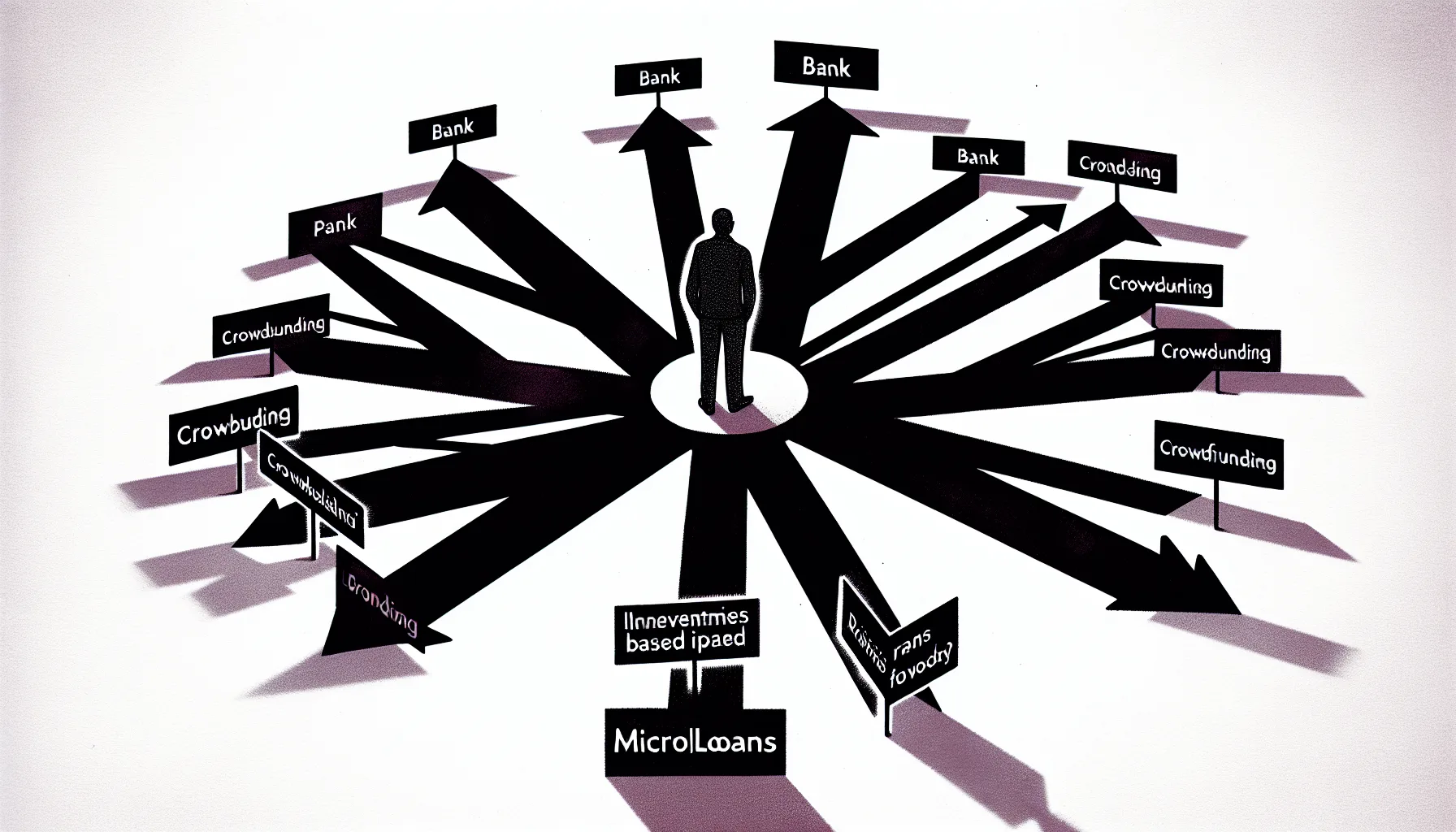
The Decision Framework: Which Path Fits You?
Stop thinking about these as a ranked list from best to worst. They’re different tools for different situations. Here’s how to match your situation to your funding source:
I have steady monthly revenue and need growth capital:
Revenue-based financing. Apply to 2–3 platforms, compare terms.
I have a consumer product or a compelling story:
Rewards-based crowdfunding. Start with IFundWomen if you want a women-focused ecosystem.
I need small capital ($50K or less) and I’m early-stage:
SBA microloans or lending circles. Contact your nearest Women’s Business Center for warm introductions to microloan intermediaries.
I want investment capital but can’t access VC:
Equity crowdfunding. Budget 3–6 months for campaign preparation — this isn’t fast money.
I have retirement savings and deep industry expertise:
ROBS. Consult a ROBS specialist and a financial advisor (not just one — both). Understand you’re converting retirement security into business risk.
I’ve been denied by a bank and don’t know where to start:
Start with our loan denial playbook, then come back here. Your next step depends on why you were denied.
What About Grants?
We covered grant strategy in depth in our guide to winning small business grants. Grants are non-dilutive and don’t require repayment — but they’re competitive, time-consuming to apply for, and unpredictable. Don’t build your funding strategy around grants alone. Think of them as supplementary capital, not your primary funding source. For programs accepting applications right now, see the September 2026 grant window.
The Bigger Picture
The traditional funding path — bank loan or VC — was built by and for a demographic that doesn’t look like most women business owners. That doesn’t mean you have to force yourself through a system designed to say no to you. The non-bank ecosystem is growing, and in several channels, the playing field is already more level than traditional lending.
The gap isn’t just about access to capital. It’s about knowing the full map of what’s available. Now you have it.
For more on how Lendesca is working to connect women business owners with the right financing options, explore our resource library. Understanding which door to walk through is half the battle — and you don’t have to figure it out alone.