
Venture capital dominates the conversation about startup funding. It shouldn’t. VC accounts for less than 1% of new business financing in the United States, yet it absorbs roughly 95% of the media oxygen. Meanwhile, a parallel funding ecosystem has been growing — quietly, deliberately, and with a specific thesis: women-led companies are undervalued, and the investors willing to act on that thesis are making money.
This guide is about those investors. Specifically, it’s about the women-focused angel networks that write $50K to $500K checks, move faster than institutional funds, and don’t require you to pitch a $10 billion TAM with a straight face. If you’re a woman founder doing $100K to $2M in revenue and you need capital to grow — not to survive, but to accelerate — this is the funding layer you should understand.
Not because it’s the nice option. Because it might be the smart one.
The Funding Layer Between Grants and VC That Nobody Talks About
There’s a gap in the funding landscape that most guides skip over entirely. Below $50K, you have grants, microloans, and bootstrapping. Above $2M, you have institutional venture capital. Between those two? A zone that matters enormously for early-revenue businesses — and it’s where angel networks live.
Angel networks pool capital from individual accredited investors who invest collectively. Typical check sizes range from $25K to $500K, sometimes up to $1M when a syndicate comes together. The terms tend to be more flexible than VC. The dilution tends to be lower. And the timeline from first meeting to wire transfer is measured in months, not quarters.
Here’s what’s changed recently: women-focused angel networks have grown by more than 40% in the past three years, according to data from the Angel Capital Association. Golden Seeds, the oldest and largest of these networks, has deployed over $200 million since its founding. This isn’t a niche anymore. It’s an asset class.
Why does this matter? Because the structural funding gap isn’t closing from the top. Eighty-nine percent of VC dollars still go to all-male founding teams. That number has barely moved in a decade. Angel networks bypass those gatekeepers entirely — different investors, different criteria, different rooms.
One thing to be clear about: these are not charity organizations. Angel investors expect returns. They perform due diligence. They negotiate terms. They’re choosing to invest in women-led companies because they believe the market has mispriced them — and the data backs that up. Companies with at least one woman founder generate 78 cents per dollar of investment, compared to 31 cents for all-male teams. That’s not philanthropy. That’s a thesis.
The Major Networks and What Makes Each One Different
Not all angel networks operate the same way. Knowing which one fits your company — stage, sector, geography, check size — saves you months of misallocated effort. Here’s how the major players compare.
Golden Seeds
The largest and oldest women-focused angel network in the U.S. Over 300 members across 8 chapters (New York, Boston, Dallas, Atlanta, Silicon Valley, and more). Typical investments range from $250K to $1M, usually into companies at the revenue stage. They run structured Open Houses and Office Hours — these are your entry points. Golden Seeds prefers companies with at least $100K in annual revenue and a clear path to profitability. They invest across sectors but tend to favor healthcare, consumer products, and enterprise software.
37 Angels
NYC-based with national reach. 37 Angels invests in both women and men but runs dedicated programs for women founders. What makes them distinctive: they also operate an investor training bootcamp, which means they’re constantly building the supply side of capital alongside the demand side. This dual pipeline approach means more new angel investors writing checks each year. If your company overlaps with consumer, health, or fintech, pay attention to this one.
Pipeline Angels
Focused specifically on women, non-binary, and trans founders. Pipeline Angels has a clear social impact orientation — they’re looking for companies that generate both financial returns and measurable social outcomes. Chapters operate in New York, San Francisco, Boston, and Austin. If your business sits at the intersection of profit and purpose, this is the network that speaks your language. Typical investments are smaller — $25K to $100K — but they often invest alongside other networks.
Portfolia
A different model entirely. Portfolia operates as a fund-of-funds: members invest $10K to $50K into curated thematic portfolios (FemTech, enterprise, consumer) rather than picking individual companies. This lowers the barrier to entry for investors, which means more total capital flowing. For founders, the process feels more like applying to a fund than pitching a room of individuals. If your company fits neatly into one of their thesis areas, the match can be strong.
EPIC Angel Network
Runs a distributed diligence model where members commit $50K to $250K annually across 5 to 10 deals. Each deal gets a sector-specific lead who runs point on diligence. This produces unusually thorough vetting — which means a longer process but higher signal. If you survive EPIC’s diligence, you’re walking away with a credibility stamp that matters for future raises.
Others Worth Knowing
- Belle Capital — West Coast focus, consumer and healthcare sectors
- Next Wave Impact — trains diverse angel investors, expanding the capital pool
- Astia Angels — global network, invests across stages, strong in enterprise and health
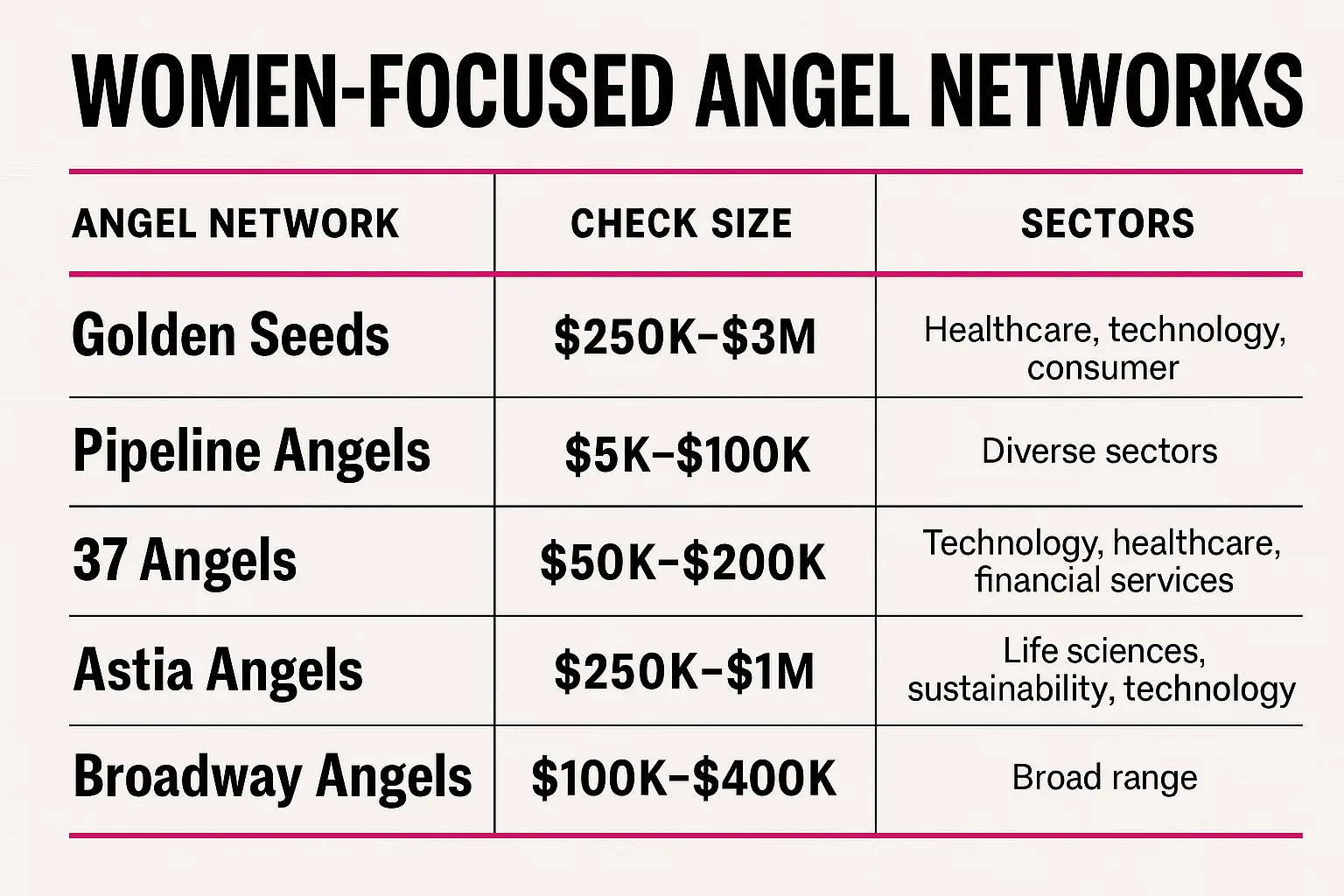
Quick Comparison
| Network | Typical Check | Sectors | Geography | Application |
|---|---|---|---|---|
| Golden Seeds | $250K–$1M | Broad (health, consumer, enterprise) | National, 8 chapters | Open House / referral |
| 37 Angels | $50K–$250K | Consumer, health, fintech | NYC-based, national deals | Application + pitch |
| Pipeline Angels | $25K–$100K | Social impact, broad | NY, SF, Boston, Austin | Application + pitch |
| Portfolia | $100K–$500K (fund) | Thematic portfolios | National | Fund application |
| EPIC Angel Network | $50K–$250K | Sector-specific | Distributed | Referral + diligence |
What Angel Networks Actually Look For (It’s Not What VCs Want)
If you’ve been prepping for VC pitches, recalibrate. Angel networks evaluate differently — and if you walk in with a VC deck, you’ll miss the mark.
Revenue traction over TAM projections
Most women-focused angel networks want to see $100K or more in annual recurring revenue, or at least a clear and documented path to it. They care about what you’ve already sold, not what you could theoretically sell if every assumption breaks your way. Bring your revenue numbers, your growth rate, and your unit economics. Leave the $50 billion addressable market slide for the VCs.
Founder-market fit over pedigree
Angel networks care significantly less about whether you went to Stanford or worked at McKinsey. What they want to know is: why are you the person to build this specific company? Domain expertise, industry relationships, lived experience with the problem — these carry more weight than a resume. If you’ve spent 15 years in an industry and spotted a gap no one else is filling, that’s the story.
Coachability and transparency
Angels are hands-on investors. Many will want advisory roles or board observer seats. They’re choosing to work with you, not just invest in you. That means they’re evaluating whether you take feedback, whether you’re honest about what’s working and what isn’t, and whether you’ll actually pick up the phone when things get hard.
Realistic valuation expectations
This is where founders who’ve been reading too many TechCrunch headlines get into trouble. At the angel stage, typical pre-money valuations are $2M to $5M. Not $20M. If you price yourself out of the market, angel networks will pass — not because they don’t believe in you, but because the math doesn’t work for their return model.
Social proof that isn’t just hype
Previous customers, signed pilot contracts, a credible advisory board, repeat purchase rates — angels want evidence that someone other than you believes in this. Letters of intent, customer testimonials, and channel partnerships all count.
What they DON’T care about
- Hockey stick projections with no basis in current data
- Billion-dollar TAM claims
- “Uber for X” comparisons
- How many Twitter followers you have
How to Actually Get in Front of Them
Knowing these networks exist is step one. Getting into the room is step two, and it requires a different playbook than cold-emailing VCs.

Warm introductions change everything
A warm introduction from someone in the network’s ecosystem has roughly 10x the success rate of a cold application. This isn’t gatekeeping for its own sake — it’s signal filtering. Angel investors receive hundreds of inbound pitches. A referral from a trusted source means someone has already done a preliminary screen on your behalf.
Start building these relationships before you need capital. Attend public events hosted by the networks you’re targeting. Join adjacent communities. Ask founders who’ve raised angel capital for introductions — most will help.
Use structured entry points
Golden Seeds runs Open Houses and Office Hours specifically designed as entry points for new founders. These are the front door. Show up, present concisely, and if there’s interest, you’ll be invited to a deeper screening. 37 Angels and Pipeline Angels accept direct applications through their websites — but even there, a warm referral moves you to the top of the pile.
Accelerator pipelines matter
Programs like Springboard, MergeLane, and The Vinetta Project are designed to feed founders directly into angel networks. Completing one of these programs doesn’t guarantee funding, but it gives you two things: pitch refinement and warm introductions to investors who trust the accelerator’s selection process. If you’re 6 to 12 months away from raising, an accelerator is often the best investment of your time.
Rebuild your pitch deck
Angel decks are not VC decks. Shorter. More focused on unit economics. Less focused on vision. The “investable narrative” for an angel audience centers on: here’s what I’m building, here’s what I’ve already proven, here’s exactly how I’ll use your capital, and here’s how you get a return. It’s the difference between a growth narrative and an economics narrative. Angels want to understand your margins, not your world domination plan.
The Process From Introduction to Term Sheet
Expect the angel raise to take two to four months from first meaningful contact to money in your account. That’s faster than a typical VC round but slower than a bank loan or revenue-based financing. Know the timeline so you can plan around it.
Stage 1: Screening
Your application or referral gets reviewed. A small committee decides whether to invite you to present. This takes one to three weeks. Most networks screen monthly.
Stage 2: Pitch event
You present to the broader membership — usually 15 to 30 minutes with Q&A. This isn’t the close. It’s the audition. Individual members who are interested will signal intent to dig deeper.
Stage 3: Due diligence
One angel typically takes the lead — the “lead investor” — and runs diligence on behalf of the group. Expect them to review your financials, call your customers, examine your legal structure, and run a background check. This is the most intensive phase, lasting two to six weeks. Be ready with clean books, a clear cap table, and references who will actually pick up the phone.
Stage 4: Term sheet
The legal structure at this stage is usually a convertible note, a SAFE (Simple Agreement for Future Equity), or a priced equity round. Convertible notes and SAFEs are more common for smaller raises because they’re faster and cheaper to close. A priced round makes more sense above $500K.
This is the stage where understanding how different financing instruments interact becomes critical — especially if you already have debt on the books or plan to take on debt later. Lendesca is a useful resource for thinking through how equity from an angel round fits alongside other elements of your capital stack, particularly if you’re weighing debt-versus-equity tradeoffs.
Stage 5: Close
Individual members commit their amounts. Funds are wired. Documents are signed. In a group model, not every member of the network participates in every deal — some might invest $10K, others $100K, depending on their individual conviction.
What Happens After the Check Clears
Taking angel money isn’t a transaction. It’s a relationship. Know what you’re agreeing to before you sign.
Active vs. passive investors
Some angels write a check and disappear. Others expect monthly calls, quarterly reports, and a seat at the table when strategic decisions are made. Angel networks tend to produce active investors — people who joined the network specifically because they want to be involved. They chose a network over solo investing because they want deal flow, community, and engagement. That energy gets directed at you.
Clarify expectations during the term sheet negotiation, not after the wire. Ask directly: how involved do you want to be? What does communication look like? What decisions do you expect input on? Getting alignment on this before closing prevents the single most common founder-angel conflict.
Board seats and advisory roles
At the angel stage, a formal board seat for an investor is uncommon but not unheard of. Board observer seats and advisory roles are more typical. Regardless of the formal structure, your lead investor will expect regular communication — financials, milestones, challenges, and asks. Build this into your operating rhythm from day one.
The value beyond capital
The best reason to raise from an angel network isn’t the money. It’s the Rolodex. Angel investors in these networks tend to be former executives, operators, and industry specialists. They make introductions to customers, partners, and future investors. This is the compounding return that doesn’t show up on the cap table.
Follow-on dynamics
Many angel networks participate in follow-on rounds. If you raise a $300K angel round and later pursue a Series A, your angel investors can bridge the gap, signal confidence to institutional VCs, and sometimes co-invest alongside the lead VC. Having organized angel investors — rather than a scattered group of friends and family — makes this process dramatically smoother.
Managing the group
One complexity of angel network raises: you may end up with 10 to 20 individual investors. This is manageable if you designate a lead and communicate through structured updates. It becomes chaotic if you try to manage 20 individual relationships. Set the cadence early. Monthly email updates. Quarterly calls. Annual in-person if possible.
When Angel Networks Are NOT the Right Path
Angel capital is powerful, but it’s not universal. Here’s when you should look elsewhere.
You need capital in 30 days or less. Angel network processes take two to four months minimum. If you need money now, look at revenue-based financing, lines of credit, or the full non-bank funding map for faster options.
You don’t want equity partners. Angel investors own a piece of your company. If that’s a dealbreaker, explore debt financing, grants, or revenue-based models. Building your business credit profile early gives you more non-dilutive options later.
Your business isn’t designed to scale. Angel investors need a return, which means they need growth and an eventual exit — acquisition, IPO, or buyback. If you’re building a profitable lifestyle business (and there’s nothing wrong with that), angel funding creates misaligned incentives. Consider SBA loans or non-dilutive capital instead.
You’re pre-revenue with no traction. Most women-focused angel networks want to see at least some revenue or very strong evidence of product-market fit — signed LOIs, pilot customers, or a waitlist with real conversion data. If you’re earlier than that, start with grants, accelerators, or microloans to build the traction that makes you investable.
You haven’t mapped your full options. Before committing to any single funding path, understand what VCs actually ask women founders and how it compares to the angel experience. The more informed you are about the landscape, the better your negotiations will be.
The Bottom Line
Venture capital isn’t the only game in town. For women founders between $100K and $2M in revenue, angel networks represent a funding channel that’s better capitalized, more accessible, and more aligned than it’s ever been. The networks exist. The capital is there. The investors are actively looking for deals.
Your job is to know which room to walk into, what to say when you get there, and what you’re agreeing to when the term sheet arrives.
Start with the network that fits your stage and sector. Build the relationships before you need them. And when you’re ready to raise, bring your numbers — not your aspirations.
The money is there. Go make the case.