
The Largest Cohort of Women Founders Is the One Nobody’s Funding
More than half of women-owned businesses in the United States are started by women over 40. The average age of a successful founder is 45, according to research from MIT Sloan. Women aged 45–54 represent one of the fastest-growing segments of new business owners in the country.
Read that again: the majority of women-owned businesses are launched by women in their forties, fifties, and beyond.
Now look at the funding infrastructure. Every pitch deck template is designed for a 28-year-old with a prototype. Every accelerator cohort photo looks like a college reunion. Every SBA lending checklist asks for “years in business” — not “years of professional experience.”
The result is a dead zone. Too experienced for startup programs. Too new for established-business lending. Too old for the VC mythology that equates youth with innovation. And too invisible for a funding system that was built to serve either the 25-year-old disruptor or the 55-year-old incumbent — but not the 47-year-old former operations VP who just launched the consulting firm she’s been planning for a decade.
This piece maps that dead zone — and the specific strategies for navigating through it.
The Age-Gender Bias Compound
Gender bias in business lending is well-documented: women face a 16-point approval gap at large banks, receive median loans roughly half the size of men’s, and encounter discouragement rates nearly double those of male applicants.
Age bias in entrepreneurship is also documented: older founders face skepticism about adaptability, technology fluency, and growth ambition — despite data showing they outperform younger founders.
What nobody quantifies is the intersection.
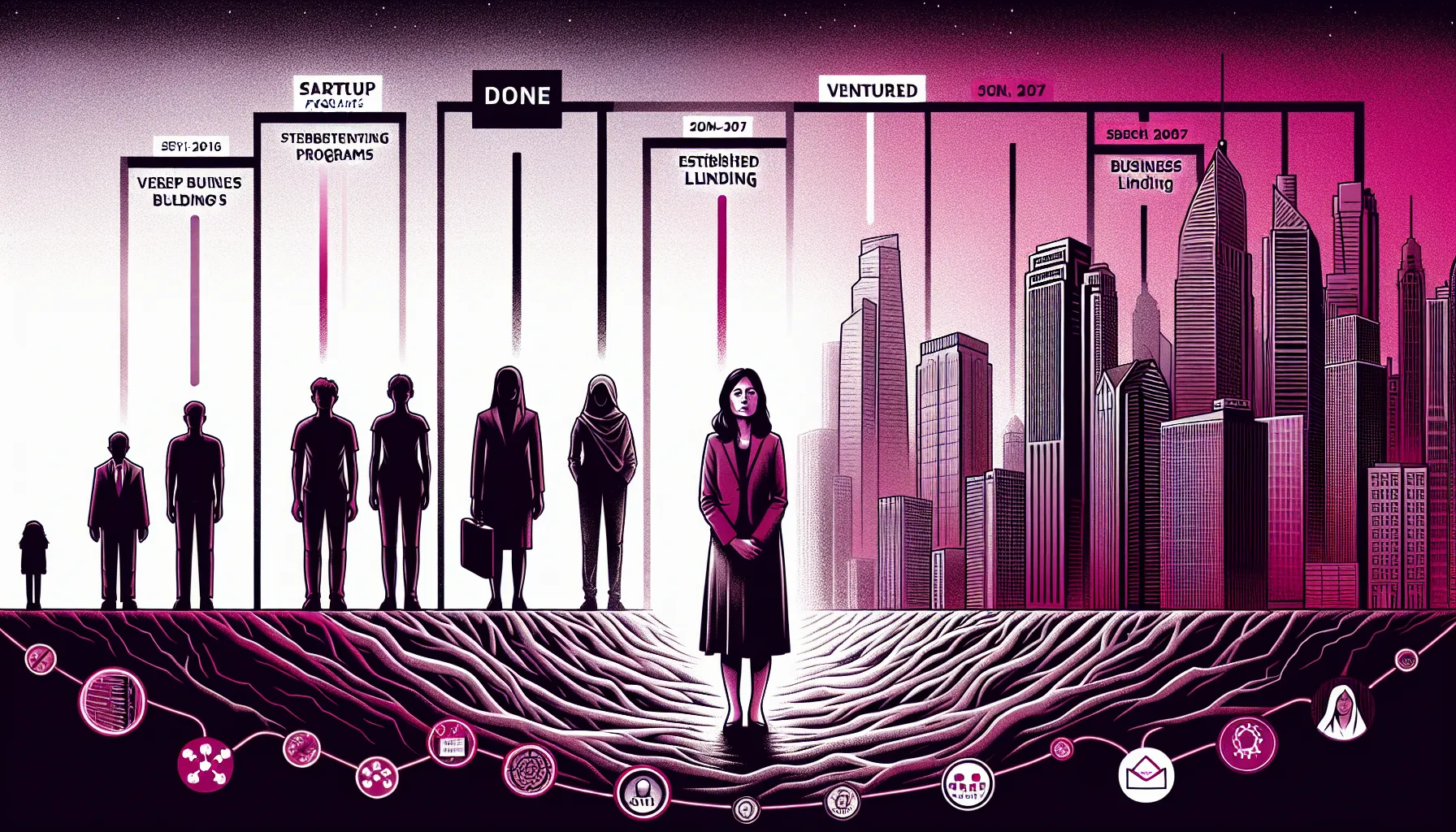
When gender bias meets age bias, the compound effect isn’t additive. It’s multiplicative. A 48-year-old woman launching a professional services firm faces:
- The “lifestyle business” dismissal. Lenders and investors who assume a post-corporate venture is a hobby — a retirement project dressed up as a business plan. Male counterparts launching at the same age face this less often because the default assumption for men pivoting from corporate is “serial entrepreneur.” For women, it’s “she wanted flexibility.”
- The VC pitch culture penalty. Venture capital mythologizes the young founder narrative. The dropout in a garage. The college roommates with a whiteboard. When a woman in her late forties walks into a pitch meeting, the cultural scripts don’t fit — even though MIT Sloan research shows that founders in their mid-forties to mid-fifties have the highest rates of entrepreneurial success.
- The years-in-business trap. SBA lending, bank credit policies, and algorithmic lending models all weight “years in business” heavily. A business that’s six months old gets treated as high-risk regardless of whether the operator has 25 years of relevant industry experience. The model measures the wrong variable — it should measure operator risk, not entity risk.
Why the System Gets It Wrong
The funding system’s bias against second-act founders isn’t just unfair — it’s wrong on the merits.
Older entrepreneurs outperform. MIT Sloan’s analysis of high-growth entrepreneurship found that entrepreneurs in their mid-forties through mid-fifties start the highest-growth companies. Not despite their age — because of it. Industry knowledge, management experience, professional networks, and financial stability all compound into an operator profile that’s lower risk than a younger founder by virtually every measure that matters.
Women over 40 bring specific advantages:
- Deeper professional networks built over decades — not the broad-but-shallow networks of early-career founders
- Industry-specific expertise that reduces learning-curve risk
- Management and leadership experience that makes hiring and team-building less hazardous
- Personal financial stability — many second-act founders have savings, home equity, or retirement assets that reduce personal financial risk
The risk profile favors them. A 48-year-old launching a consulting firm with 22 years of healthcare management experience, a paid-off car, a FICO score of 780, and $150K in retirement savings is objectively lower-risk than a 27-year-old with a prototype and $30K in student loans. But the 27-year-old fits the funding system’s templates. The 48-year-old doesn’t.
Burnout as a driver isn’t a weakness — it’s a signal. Research shows that burnout is the leading reason women explore career pivots after 40. But women leaving corporate aren’t fleeing. They’re redirecting decades of expertise into businesses they can own. The lender who reads “left corporate after 20 years” as instability is reading it wrong. The correct read is: experienced operator, high motivation, proven track record, ready to build. If you’re leaving an employer, check the state noncompete laws that affect your startup timeline — enforceability varies dramatically by state and directly impacts your funding readiness.
The Five Funding Barriers Specific to Second-Act Founders

1. Years-in-Business Requirements
Most traditional bank loans and SBA programs weight business age heavily. A business operating for less than two years is high-risk by default — regardless of the operator’s two decades of industry experience. The workaround: CDFIs and mission-driven lenders evaluate the founder holistically. SBA microloans have more flexible eligibility for newer businesses.
2. Revenue History Expectations
Lenders want 12–24 months of business revenue data. A career changer in month six has personal income history, savings, and assets — but no business revenue. The system asks the wrong question: “How much has this business earned?” instead of “How capable is this operator of making this business earn?”
3. Accelerator and Program Age Caps
Few accelerators have explicit age limits. Many have implicit ones — cohort culture, networking events built around a younger demographic, mentors who are younger than the founders they’re advising. The result: women over 40 self-select out of programs that could provide capital, connections, and credibility.
4. Personal Financial Complexity
A 28-year-old founder’s personal guarantee is relatively simple. A 48-year-old’s is layered: mortgage, college savings, retirement accounts, aging-parent obligations, and the maternity penalty that still haunts lending profiles. The personal guarantee isn’t just a legal instrument — it’s a family financial decision. Second-act founders rightfully assess this risk more carefully, and lenders who interpret caution as lack of commitment are misreading the signal.
5. The “Hobby Business” Dismissal
Perhaps the most insidious barrier. When a woman in her late forties launches a business, the default assumption — from lenders, family, even friends — is often that it’s a side project. A thing she’s doing “for herself.” The language alone tells you: “her little business,” “her passion project,” “keeping busy.” Nobody calls a 48-year-old man’s consulting firm a hobby.
The Second-Act Funding Playbook
The system isn’t going to fix itself on your timeline. Here’s how to navigate it as it exists:
Lead with professional credentials, not business age. Every application, pitch, and conversation should open with your 20+ years of relevant experience — not the fact that your LLC was filed eight months ago. Reframe the narrative: you’re not a new business owner. You’re an experienced operator with a new entity.
Target lenders who evaluate the operator. CDFIs — the lenders most women don’t know about — evaluate founders holistically: business plan quality, operator experience, community impact. The approval gaps at CDFIs are significantly smaller than at traditional banks. Resources like Lendesca can help match your operator profile to lenders who weight experience over entity age.
Use SBA microloans as bridge capital. The SBA microloan program (up to $50,000, administered through nonprofit intermediaries) has more flexible eligibility for newer businesses. It’s designed for exactly the gap second-act founders face: too early for traditional bank lending, too established for grants.
Access free expertise through SBDCs and SCORE. SCORE.org provides free mentorship from experienced business owners — many of whom are second-act founders themselves. Small Business Development Centers offer free counseling, business plan review, and financial projection assistance. These aren’t charity — they’re infrastructure.
Build strategic relationships before you need capital. Open a business bank account on day one. Get a business credit card and use it. Establish trade credit with vendors. Building business credit before you need it is especially critical for second-act founders because you need to build a business credit profile that matches the personal credit profile you’ve spent decades perfecting.
Don’t overlook grants and competitions. Many small business grant programs don’t have years-in-business requirements. Some specifically target women founders, career changers, or founders in specific industries. The application process also forces you to articulate your business case in a format that translates directly to loan applications later.
Consider the non-bank funding map. Revenue-based financing, peer lending circles, community loan funds, and microloans don’t penalize business age the way traditional banks do. They evaluate cash flow potential, not entity history.
The Experience Advantage Is Real — Make the System See It
The funding system’s blindness to second-act founders is an economic waste. The operators with the highest success rates — experienced, financially stable, industry-knowledgeable women in their forties and fifties — are the ones the system is least equipped to serve.
But the market is moving even if institutions aren’t. Women aged 45–54 are the fastest-growing segment of new business owners. The number of women-owned employer firms grew 11% between 2019 and 2024 — faster than the 8% growth for all employer firms. Second-act founders aren’t waiting for permission. They’re building.
Stop apologizing for starting “late.” You didn’t start late. You started ready. Twenty years of professional experience isn’t a disadvantage — it’s a moat. The funding system just hasn’t figured out how to measure it yet.
That’s the system’s problem. Not yours. Build anyway.