
The Channel Nobody Realizes They’re Losing
There are two ways a bank decides whether to lend you money.
Method one: the algorithm. Your application goes into a system. The system scores your credit history, revenue, debt ratios, collateral, and industry risk. It outputs a number. If the number clears the threshold, you advance to the next stage. If it doesn’t, you get a letter.
Method two: the relationship. A loan officer who knows you — who’s seen you at the branch for three years, watched your deposits grow, heard you explain your expansion plan over coffee — evaluates you as a whole person. They weigh “soft information”: your character, your community standing, your trajectory, your explanation for that weird quarter.
For women business owners, method two has consistently outperformed method one. And method two is disappearing.
The Branch Closure Acceleration
The numbers tell a stark story:
- 20% of all U.S. commercial bank branches have closed since 2010, according to FDIC data
- 300+ branches were marked for closure in Q1 2025 alone — Wells Fargo, TD Bank, Bank of America, JPMorgan Chase, U.S. Bank all consolidating
- The pace is accelerating: pandemic-era closures were a catalyst, but the economic logic (digital banking reduces foot traffic, branches become cost centers) ensures the trend continues
- The closures aren’t random — they disproportionately hit lower-income neighborhoods and communities of color, according to NCRC research
The Federal Reserve’s own research — Working Paper 2024-071 — proves what many business owners already felt: nearby branch closures “decrease small business employment growth and entry.” Not might decrease. Do decrease.
Why Relationship Lending Works Better for Women
The reason relationship lending disproportionately benefits women isn’t complicated. It’s that algorithms have a gender bias problem — and relationship lending bypasses the algorithm.
The Algorithmic Bias
A January 2026 research paper from arXiv (Structural Gender Bias in Credit Scoring: Proxy Leakage) proved what many suspected: even when credit scoring models exclude gender as a variable, they encode it through proxies. Variables like marital status, credit limit history, and account age correlate so strongly with gender that the model effectively “knows” the applicant’s sex — and penalizes accordingly.
The result: women receive credit scores 6-8 points lower than men with identical risk profiles. Women also default at equal or lower rates than men at the same score level — meaning the scores are systematically miscalibrated against women.
The Relationship Advantage
When a loan officer evaluates you based on soft information — your deposit history, your explanation of a revenue dip, your community reputation, your track record of meeting commitments — they’re doing something an algorithm cannot: evaluating context.
The algorithm sees a 30% revenue dip and flags risk. The loan officer sees a 30% revenue dip and remembers you told her you were taking maternity leave and would be back in April.
The algorithm sees a thin credit file and assigns a low score. The loan officer sees a thin credit file and remembers you’ve banked here for four years, always maintained your balance, and ran a clean business account.
Research from the FDIC’s Small Business Lending Survey confirms that “soft information” evaluation is “mostly a function of staff working in local branches.” No branch means no staff means no soft information means no relationship lending.
The Double Whammy
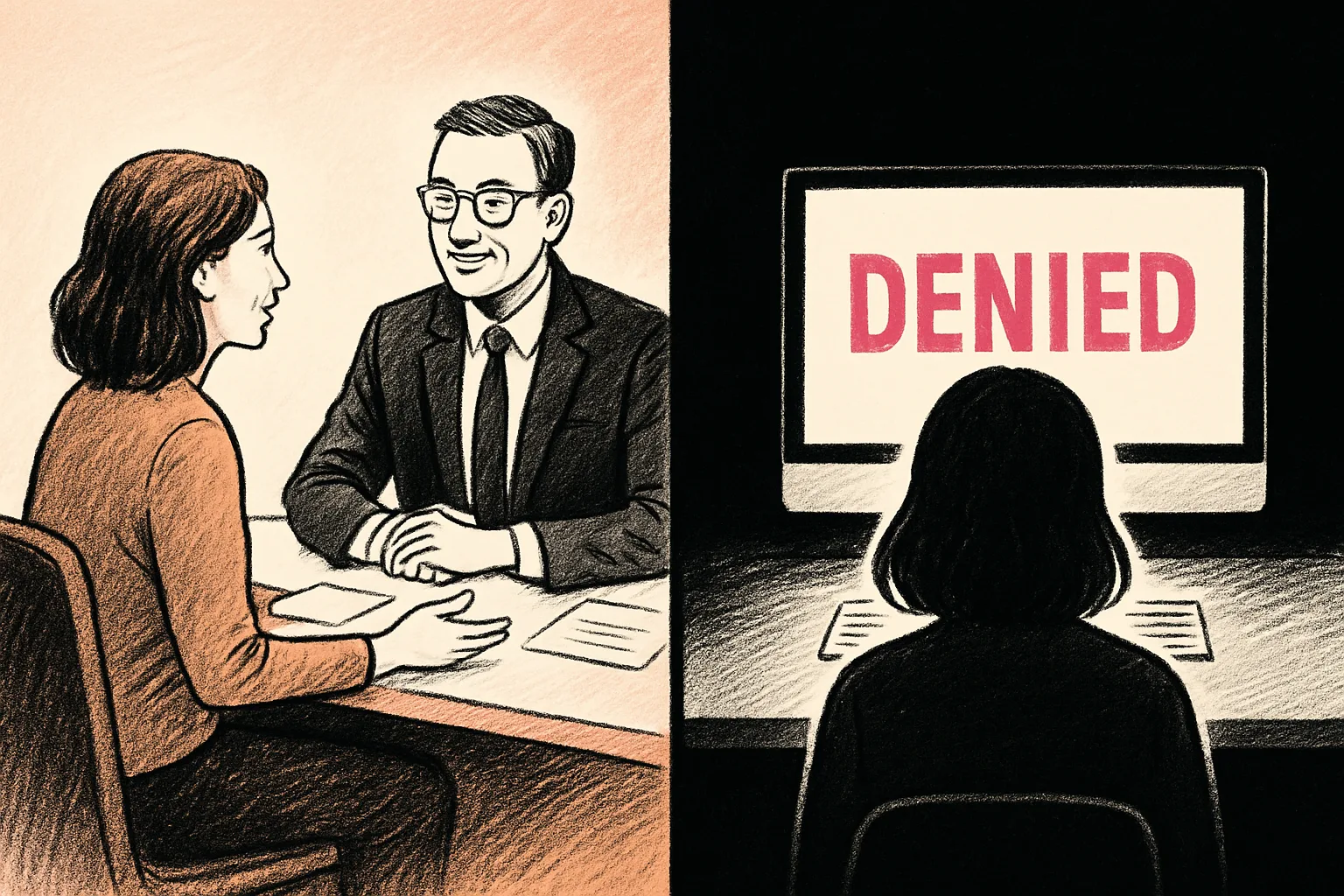
Here’s the structural problem women now face:
- The channel that worked (relationship lending) is disappearing as branches close
- The channel replacing it (algorithmic underwriting) has documented gender bias
- The communities losing branches fastest overlap significantly with the communities where women-owned businesses are concentrated
This isn’t a coincidence or a conspiracy. It’s the predictable result of banks optimizing for cost efficiency without evaluating who gets harmed by the optimization. Closing a branch saves money. The lending that branch enabled — particularly the soft-information lending that served women and minorities — becomes invisible in the P&L analysis.
What’s Actually Replacing Branches
The banking industry’s answer to branch closures is digital lending. Apply online. Get scored by the algorithm. Receive a decision in 48 hours.
For borrowers who score well algorithmically, this is convenient. For borrowers who need context evaluated — who need someone to understand WHY their numbers look the way they do — it’s a disaster.
Some replacements are emerging:
- Fintech lenders — many use alternative data (bank transaction history, payment patterns) that can be more favorable to women than traditional credit scoring. But they’re still algorithmic.
- Virtual relationship managers — some banks assign business banking clients a dedicated remote banker. But a Zoom call with someone who’s never been in your store is not the same as a banker who walks past it every day.
- AI-assisted underwriting — newer models claim to evaluate “holistically.” The January 2026 proxy leakage research suggests most still embed gender bias through proxy variables, even when they appear fair by traditional metrics.
How to Build Lending Relationships in a Branchless World
The strategic response isn’t to mourn the branch. It’s to find or create the relationship-lending dynamic in whatever channels remain.
1. Bank at Institutions That Still Value Relationships
Not all banks are closing branches at the same rate:
- Community banks — still operate primarily on relationship lending. The CDFI Fund directory lists community-oriented institutions near you.
- Credit unions — member-owned, often smaller, more likely to evaluate holistically. Business lending from credit unions grew 17% year-over-year through 2025.
- CDFI banks and loan funds — specifically designed to serve underserved borrowers using relationship-based evaluation.
2. Create Visibility Before You Need a Loan
The relationship advantage comes from the lender KNOWING you before you apply. In a digital world, you create that knowledge deliberately:
- Open your business account at a community bank or credit union — even if you also use a larger bank for convenience. Your deposit history IS your relationship.
- Attend business banking events — many community banks and SBA-aligned lenders host small business workshops. Showing up creates face recognition.
- Schedule an annual “business review” — most business bankers will meet with account holders to discuss their business trajectory. These meetings build the soft-information file that helps you when you eventually apply.
- Use the SBA’s SCORE mentoring network — free mentors who are often retired bankers. They can introduce you to lending contacts and vouch for your preparedness.
3. Build Your Own Paper Trail of Context
Since fewer lenders will know you personally, create documentation that functions as “soft information in writing”:
- Maintain a business narrative document — a one-page annual summary of your business: what happened, why revenue moved the way it did, what’s planned next. Update it yearly. Attach it to loan applications.
- Get reference letters from professional contacts — accountants, attorneys, major clients. Relationship lenders weigh these. Algorithmic systems ignore them — but you’re not applying to algorithmic systems.
- Document community involvement — if you’re active in your business community, chamber of commerce, or professional associations, this IS soft information. It signals stability and embeddedness.
4. Know Which Lenders Use What Model
Before you apply anywhere, ask: “How does your underwriting evaluate my application?” If the answer is purely algorithmic (credit score, debt ratios, automated decision), that lender has already decided to evaluate you without context.
Look for lenders who describe their process using language like:
- “Holistic evaluation”
- “Character-based lending”
- “Relationship banking”
- “Manual underwriting available”
- “We review each application individually”
Resources like Lendesca can help you identify which lenders in your area still operate with relationship-based evaluation — matching you with institutions where your full story gets heard, not just scored.
The Structural Fix
Branch closures won’t reverse. But the lending function those branches provided — contextual, relationship-based evaluation — doesn’t have to disappear with the buildings.
What would help:
- Regulatory guidance requiring “context fields” in small business loan applications — a standard place to explain revenue anomalies, career transitions, or life events
- CRA modernization that credits banks for relationship lending outcomes, not just branch presence
- Expanded CDFI funding — these institutions already do relationship lending without branches. They need scale.
- Alternative data standards that have been tested for gender bias before deployment — not after
Until then: build your business credit independently, choose your banking institutions strategically, create your own documentation of context, and find the remaining pockets of the lending world where someone will look at you — not just your numbers.
The branch is a building. The relationship is a strategy. One is disappearing. The other is up to you.