
You did the work. Filed the paperwork. Got the Women-Owned Small Business certification from the SBA. Maybe you even went further and secured your Economically Disadvantaged Women-Owned Small Business (EDWOSB) status.
Then nothing happened.
You’re not alone. In FY2024, women-owned small businesses received just $26.64 billion in federal contracts — only 3.44% of total federal contracting dollars. Congress set the goal at 5%. That goal has been met exactly twice since it was established in 1994.
The gap isn’t just a policy failure. It’s billions in uncaptured revenue sitting on the table for certified WOSBs who don’t know how to find it.
This is the playbook for turning a certificate into contracts.
The Federal Contracting Pipeline (and Where Most Women Drop Out)
Federal contracting isn’t one step. It’s a pipeline with five stages, and most certified WOSBs stall at stage two:
- Registration — SAM.gov, NAICS codes, UEI number
- Positioning — Capability statement, past performance, market research
- Finding opportunities — SAM.gov contract search, agency forecast research
- Bidding — Proposal writing, pricing strategy, compliance
- Winning and performing — Award, contract management, recompete positioning
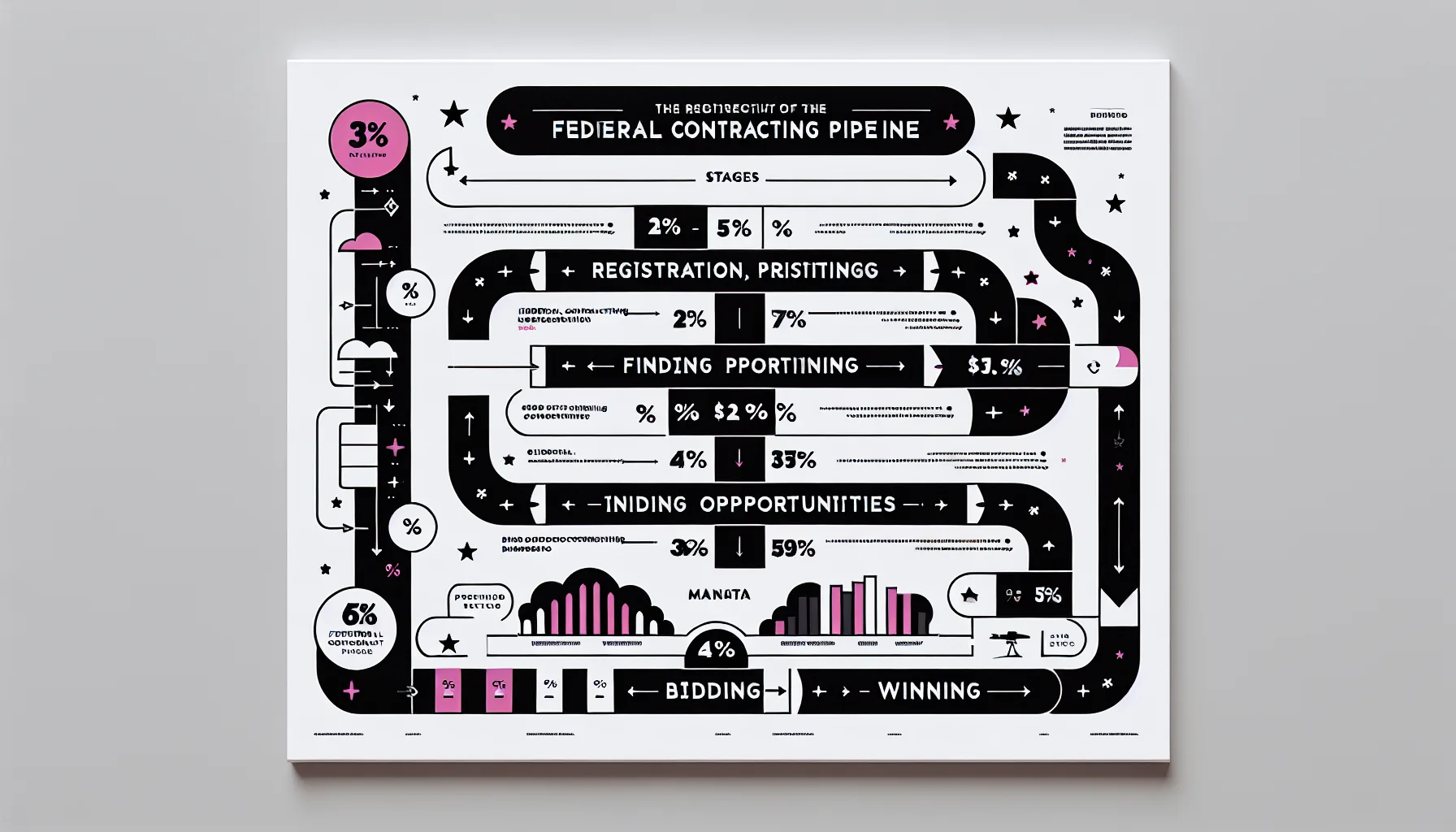
Most women complete registration and then wait for the phone to ring. The phone doesn’t ring. Federal contracting is a proactive game — agencies aren’t browsing for WOSBs. You have to put yourself in front of the contracting officers who need what you sell.
Stage 1: Get Your SAM.gov Profile Right (Most Are Wrong)
Your SAM.gov registration is your federal storefront. Contracting officers search it. If your profile is thin, generic, or missing key data, you’re invisible.
What to fix immediately:
- NAICS codes: Don’t list every code you could theoretically qualify for. List 3–5 codes where you have actual past performance and genuine capability. The WOSB program has 38 four-digit NAICS code groups with set-aside eligibility — make sure your primary codes fall within these groups.
- Core competency keywords: Contracting officers search SAM.gov by keyword. If your profile says “consulting services” instead of “cybersecurity risk assessment for federal civilian agencies,” you won’t appear in relevant searches.
- Past performance references: Even if you’ve never held a federal contract, list your best commercial or state/local contracts. Contracting officers want evidence you can deliver — not necessarily federal delivery history.
- Size standard verification: Confirm you meet the SBA size standard for each NAICS code you list. Size standards vary wildly — $9 million average annual receipts for some codes, $47 million for others. And be aware: the SBA’s proposed rule to consolidate size standards could add 114,000 new competitors entering your set-aside pool.
The EDWOSB advantage: If you qualify for EDWOSB status (personal net worth under $850,000, adjusted gross income $400,000 or less averaged over three years, total assets under $6.5 million), you unlock sole-source contracting. That means a contracting officer can award you a contract up to $4.5 million for services or $7 million for manufacturing without competing it. This is the single most powerful tool in the WOSB program — and most certified EDWOSBs don’t know it exists. (If you’re already certified, make sure you’re prepared for surviving the SBA’s EDWOSB audit.)
Stage 2: Build a Capability Statement That Actually Works
A capability statement is your one-page resume for federal buyers. It’s the document you hand a contracting officer at an industry day, attach to an email introduction, or leave behind after a meeting.
Most capability statements are terrible. They read like corporate mission statements. Contracting officers see hundreds. Yours needs to answer four questions in under 60 seconds:
The four boxes:
- Core competencies — What you do, stated specifically. Not “IT solutions” but “cloud migration for legacy federal systems, AWS GovCloud certified.”
- Past performance — 3–5 contracts (federal, state, or commercial) with client name, contract value, and one-sentence outcome. “Migrated 14 on-premises systems to AWS GovCloud for [State Agency], $1.2M, completed 6 weeks ahead of schedule.”
- Differentiators — What makes you different from the other 50 companies bidding. Security clearances held, certifications, geographic presence, niche expertise.
- Company data — DUNS/UEI, CAGE code, NAICS codes, WOSB/EDWOSB certification, any other set-aside statuses (HUBZone, 8(a) if applicable), contract vehicles you’re on.
Format rules:
- One page. Not two. One.
- Your WOSB/EDWOSB status in a visible badge or banner — not buried in paragraph text
- Contact information for a real person, not a generic inbox
- Print-ready and PDF-ready — you’ll use it both ways
Stage 3: Find the Contracts Before They’re Posted
The biggest misconception about federal contracting: you read SAM.gov, find an open solicitation, and submit a bid. That’s the worst way to win.
By the time a contract appears on SAM.gov contract opportunities, the agency usually knows who they want. The real work happens 6–18 months before the solicitation drops.
How to find opportunities early:
- Agency forecast reports: Most federal agencies publish annual procurement forecasts listing planned contracts for the coming fiscal year. Search “[agency name] small business forecast” — these are public documents that tell you exactly what agencies plan to buy and approximately when.
- Subcontracting with primes: Large prime contractors have small business subcontracting plans mandated by law. They need WOSB subcontractors to meet their goals. Search the SBA’s SubNet database for subcontracting opportunities, and attend prime contractor industry days.
- Small Business Innovation Research (SBIR): If you’re in a technical field, SBIR grants fund R&D with a path to federal contracts. The SBIR.gov portal lists open topics across all participating agencies.
- Procurement Technical Assistance Centers (PTACs): Free counseling funded by the DoD. PTACs help you identify target agencies, review solicitations, and prepare proposals. Find your local PTAC through the SBA.
- GSA Schedules: Getting on a GSA Schedule (now called Multiple Award Schedule or MAS) puts you in the government’s approved-vendor catalog. Agencies can buy from GSA Schedule holders without a full competitive bidding process for purchases under $250,000. The application takes 3–6 months but dramatically increases your visibility.
Stage 4: Win the Bid (What Evaluators Actually Look For)
Federal proposals aren’t sales pitches. They’re compliance documents first and persuasion documents second.
The evaluation hierarchy:
- Technical approach — Do you understand the requirement? Can you execute? This is usually weighted highest.
- Past performance — Have you done something similar before? Federal, state, commercial — it all counts, but federal is strongest.
- Price — Competitive but not cheapest. Unrealistically low bids signal risk. Federal contracting isn’t a race to the bottom.
- Small business participation (for larger contracts) — If you’re subcontracting, showing a diverse small business team strengthens your proposal.
Common mistakes that kill WOSB proposals:
- Ignoring Section L and Section M. Section L tells you exactly what to include and how to format it. Section M tells you exactly how it will be evaluated. These are the instructions and the grading rubric. Read them first. Build your proposal structure around them.
- Generic past performance. “We provided excellent service” means nothing. “We reduced help desk ticket resolution time from 72 hours to 8 hours, achieving a 99.2% customer satisfaction rating” means everything.
- Missing compliance requirements. One missing form, one unsigned document, one incorrectly formatted page header — and your proposal gets thrown out before anyone reads it. Federal compliance is unforgiving.
- Pricing without cost justification. If your price is 30% below competitors, the contracting officer assumes you don’t understand the scope. Include labor categories, hours, rates, and ODCs (other direct costs) in enough detail that the evaluator can verify your math.
The “no past performance” problem: Every new contractor faces this. Here’s how to build it:
- Start with subcontracting under an established prime — their contract performance becomes your reference
- Bid on simplified acquisitions (under $250,000) where past performance requirements are lighter
- Use state and local government contracts as stepping stones — many PTAC counselors specialize in this progression
- Apply relevant commercial past performance — a contract to manage IT for a regional hospital chain demonstrates the same capabilities as managing IT for a federal health agency
Stage 5: Win Once, Then Win Again
Your first federal contract changes everything. Now you have:
- A federal past performance reference
- A CPARS (Contractor Performance Assessment Reporting System) rating
- An inside understanding of how the agency operates
- Relationships with program managers and contracting officers
Protect and leverage this position:
- Deliver flawlessly. Your CPARS rating follows you for life. One “marginal” or “unsatisfactory” rating can eliminate you from future competitions. Overcommunicate with the contracting officer. Deliver early when possible. Document everything.
- Position for the recompete. Most federal contracts have a base year plus option years, then get recompeted. Start preparing your recompete proposal 12 months before the contract ends. The incumbent advantage is real — use it.
- Cross-sell within the agency. Once you’re performing well for one office, introduce yourself to adjacent offices. The contracting officer who likes your work will often make warm introductions.
- Scale through vehicles. GSA Schedule, Best-in-Class (BIC) contracts, Government-Wide Acquisition Contracts (GWACs) like Alliant 2 Small Business — each vehicle expands the agencies that can buy from you without a new competition.
The Numbers You Need to Know
| Metric | Value |
|---|---|
| Federal WOSB contracting goal | 5% of all federal contract dollars |
| FY2024 actual WOSB share | 3.44% ($26.64B) |
| EDWOSB sole-source ceiling (services) | $4.5 million |
| EDWOSB sole-source ceiling (manufacturing) | $7 million |
| NAICS code groups with WOSB set-asides | 38 four-digit codes (150+ six-digit) |
| Simplified acquisition threshold | $250,000 |
| GSA Schedule application timeline | 3–6 months |
| WOSB/EDWOSB recertification cycle | Every 3 years |
Your 90-Day Action Plan

Days 1–30: Foundation
- Audit your SAM.gov profile — update NAICS codes, keywords, and past performance
- Build or rebuild your capability statement using the four-box format
- Identify your 3 target agencies based on your NAICS codes and what they buy
- Contact your local PTAC and schedule an intake appointment
Days 31–60: Market Research
- Pull procurement forecasts for your 3 target agencies
- Identify 5 prime contractors in your space and research their small business subcontracting plans
- Attend at least one virtual or in-person industry day
- Research whether a GSA Schedule makes sense for your business
Days 61–90: First Bids
- Submit at least one proposal — even if you don’t win, the process teaches you the system
- Apply for GSA Schedule if your PTAC counselor recommends it
- Set up automated alerts on SAM.gov for your target NAICS codes
- Follow up with every contracting officer and prime contractor contact you’ve made
The government wants to buy from you. They set aside contracts specifically for women-owned businesses. The money is there. The certification is done.
Now go get it.
Related reading on HerCapital:
- How to Get WOSB Certified — and Why the ROI Is Higher Than You Think
- State and Local Funding Programs for Women-Owned Businesses
- Financial Statements That Make Lenders Say Yes
- AI-Powered Funding Applications: How to Use AI to Get Your Grant, Loan, or Pitch Over the Line
- The Non-VC Pitch: How to Present Your Business to Banks, Grants, and Everyone Else