
You just left a pitch meeting feeling great. You answered every question clearly, confidently, thoroughly. Your deck was tight. Your numbers were solid.
Then the rejection email hits. “Not a fit right now.” No real feedback.
Here’s what nobody told you: the problem wasn’t your answers. It was their questions. And unless you learn to recognize what’s happening in real time, it will keep happening — no matter how polished your pitch gets.
The Study That Explains Everything
Researchers Dana Kanze, Laura Huang, Mark Stangl, and Jing Zheng spent six years studying investor behavior at TechCrunch Disrupt — one of the highest-profile startup competitions in the world. They analyzed Q&A sessions for 189 startups between 2010 and 2016, coding every single question investors asked.
What they found was damning.
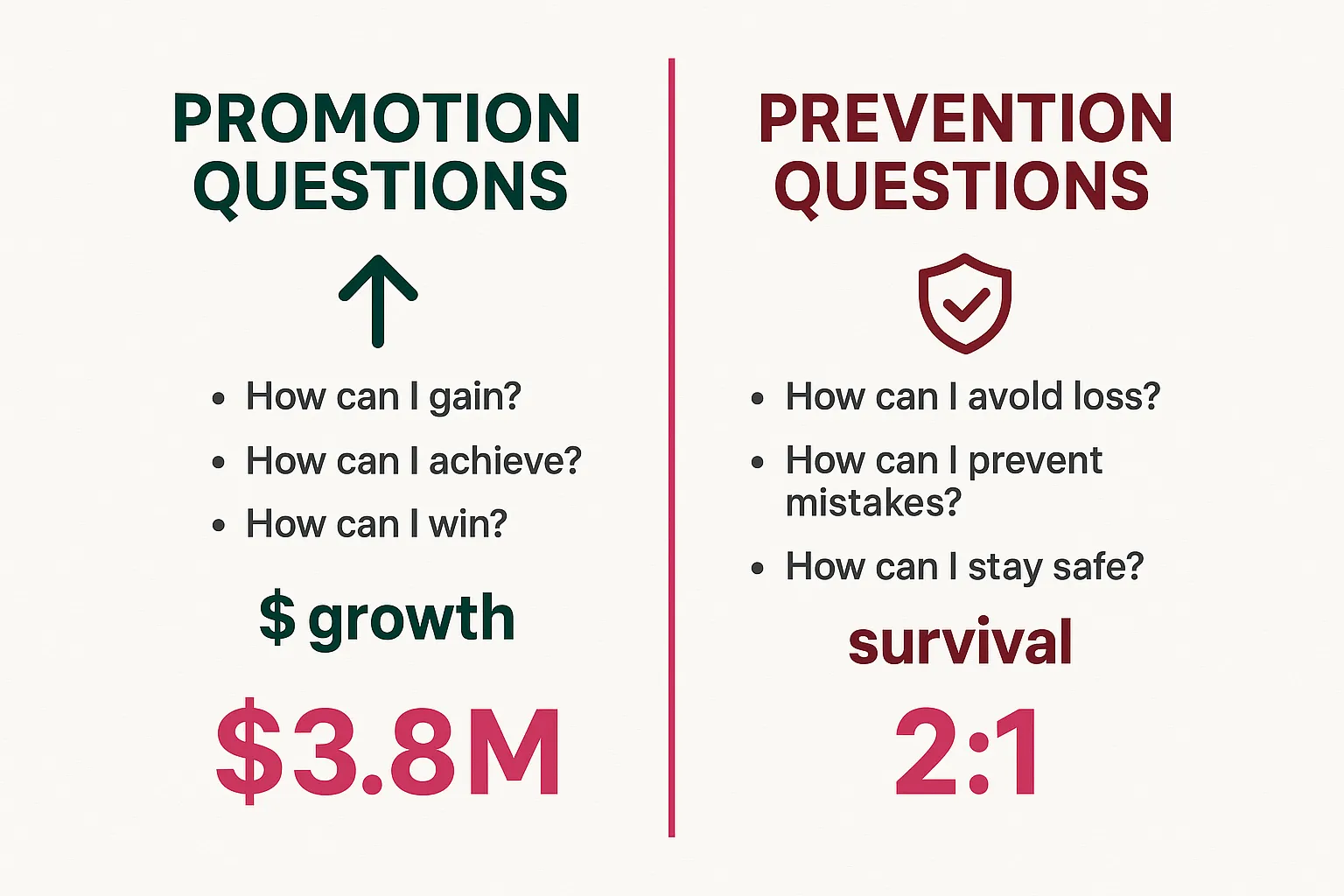
Investors asked male founders promotion-oriented questions — questions about growth, opportunity, upside, and vision. They asked female founders prevention-oriented questions — questions about risk, loss, defense, and survival. The ratio wasn’t subtle. Women received prevention questions at roughly 2:1 compared to men.
And here’s where the data turns into ammunition: each additional prevention question a founder received correlated with $3.8 million less in funding raised. Startups that were asked primarily prevention questions raised an average of approximately $500,000. Startups asked primarily promotion questions? $7.9 million.
Same competition. Same judges. Same stage. Sixteen times less capital — driven by the framing of questions founders didn’t choose.
Both male and female investors exhibited this bias. This isn’t a “bad guys” problem. It’s a systemic pattern baked into how people unconsciously evaluate women versus men in high-stakes financial settings.
What Prevention vs. Promotion Questions Actually Sound Like
The distinction is subtle enough to miss in the moment — which is exactly why it works. Here’s what each type sounds like:
Promotion Questions (What Men Get Asked)
- “How do you intend to acquire customers?”
- “What does your revenue forecast look like over three years?”
- “How big is the market opportunity?”
- “What’s your vision for scaling this nationally?”
- “Which adjacent markets could you expand into?”
These questions invite you to paint a picture of growth, ambition, and upside. They let you talk about the best version of your company’s future.
Prevention Questions (What Women Get Asked)
- “What does customer retention look like?”
- “Are you operating at breakeven?”
- “How do you prevent competitor entry?”
- “What happens if your biggest customer leaves?”
- “How do you protect your margins in a downturn?”
These questions force you into defense mode. You’re explaining why your business won’t fail instead of why it will succeed. Even when you answer perfectly, you’ve spent your airtime on survival — not growth.
The Harvard Gender Action Portal documented this dynamic clearly: we ask men to win, and women not to lose. Same meeting, completely different playing field.
This Isn’t Just a VC Problem
If you’re thinking “I’m not raising venture capital, so this doesn’t apply to me” — think again.
The prevention-question bias shows up everywhere money changes hands:
- SBA lender meetings: “What’s your plan if revenue drops 30%?” instead of “What’s your growth plan for the next 12 months?”
- Angel pitch events: “How will you handle cash flow gaps?” instead of “What’s the return potential for early investors?”
- Bank loan interviews: “What collateral do you have if this doesn’t work?” instead of “What will this capital help you build?”
- Grant applications: Review committees that weight risk sections more heavily for women-led ventures
The framing follows you whether you’re raising $50K or $50M. And it connects directly to the ask gap — women don’t just ask for less; they’re evaluated through a lens that makes every ask feel riskier than it actually is.
When you’re pitching non-VC sources like banks and grants, the same dynamic applies with different vocabulary. A loan officer asking “What if you can’t make payments?” is asking a prevention question. Recognizing it is the first step to redirecting it.
The Redirect Technique: Promotion-Frame Every Answer
The Kanze et al. research didn’t just identify the problem — it found the solution. Founders who answered prevention questions with promotion-framed responses raised funding amounts comparable to founders who were asked promotion questions in the first place.
Read that again. The redirect works.
Here’s the method: when you get a prevention question, acknowledge the concern briefly, then pivot to the growth signal it implies. You’re not dodging the question. You’re reframing your answer so the investor hears opportunity, not risk.
Redirect #1: Customer Retention
They ask: “What does your customer retention rate look like?”
You say: “Our customers come back because we’ve nailed a pain point nobody else is solving — our repeat purchase rate is 84%, which means we’ve found product-market fit that fuels organic growth. That retention is actually our most efficient acquisition channel because referrals from existing customers convert at 3x the rate of paid ads.”
Why it works: You answered the question (84% retention) but spent 80% of your airtime on what that retention enables — growth through referrals and efficient acquisition.
Redirect #2: Breakeven Timeline
They ask: “Are you operating at breakeven?”
You say: “We’ve deliberately invested ahead of breakeven to capture a market window that won’t stay open. Our unit economics are profitable at $47 per customer, and we expect to cross full profitability in Q3 as volume scales. The companies that win in this space will be the ones who invested in infrastructure now — not the ones who played it safe.”
Why it works: “Deliberately invested” reframes pre-profitability as strategy, not weakness. You gave the timeline they wanted but positioned it as a choice, not a problem.
Redirect #3: Competitive Defense
They ask: “How do you prevent competitors from entering your market?”
You say: “We actually welcome competition because it validates the market size — which we estimate at $2.3 billion. Our advantage isn’t a moat around the market, it’s a head start. We have 18 months of customer data, three signed enterprise contracts, and switching costs that increase the longer clients use our platform. Every month we operate, the gap widens.”
Why it works: You flipped “defense” into “offense.” Instead of explaining how you’ll survive competitors, you explained why your position gets stronger over time.
Redirect #4: Key Customer Risk
They ask: “What happens if your biggest customer leaves?”
You say: “No single customer represents more than 15% of revenue — we built the business that way intentionally. More importantly, our pipeline has $800K in qualified opportunities right now, and our average sales cycle is shortening. We’re diversifying by growing, not by shrinking.”
Why it works: The brief risk answer (no concentration) is the appetizer. The entrée is the pipeline and momentum data.
Redirect #5: Market Downturn Resilience
They ask: “How would your business perform in a recession?”
You say: “We actually see downturns as an accelerant for our model. When budgets tighten, companies look for exactly what we offer — a way to get the same output at 40% of the cost. Our comparable in the 2020 downturn grew 22% while incumbents contracted. Economic pressure pushes customers toward us, not away.”
Why it works: You transformed “survive a recession” into “thrive in a recession.” The investor now sees downside scenarios as upside catalysts.
Redirect #6: Cash Flow Gaps
They ask: “How do you handle months where cash flow is negative?”
You say: “We manage cash strategically — we accelerate spend during high-ROI months like Q1 and Q4 when customer acquisition costs drop 30%. Our 14-month runway gives us the room to be aggressive on timing. The negative months aren’t gaps — they’re investments with 90-day payback cycles.”
Why it works: “Strategic cash management” sounds like a growth tactic. “Cash flow gaps” sounds like a crisis. Same facts, entirely different framing.
As Antler’s research on preventative questions notes, founders who learn to reframe don’t just raise more — they change the entire tenor of the conversation. One well-executed redirect often shifts the investor’s subsequent questions toward promotion territory too.

The Preparation Framework: Predict and Pre-Load
Knowing the redirect technique isn’t enough if you freeze in the moment. You need a system for anticipating prevention questions before you walk into the room.
Step 1: Audit Your Pitch for Prevention Triggers
Go through your deck slide by slide. Every time you mention a risk, a challenge, or a “we’re working on it” — flag it. Those are the slides that will generate prevention questions.
- Slide mentions early-stage revenue? Expect “Are you profitable?”
- Slide shows a competitive landscape? Expect “How do you defend against X?”
- Slide references a small team? Expect “What if a key employee leaves?”
Step 2: Write Your Redirects in Advance
For every prevention trigger you identified, write a promotion-framed response. Practice it out loud until it feels natural, not rehearsed.
Keep a simple two-column document:
| Prevention Question | Promotion Redirect |
|---|---|
| “What if growth stalls?” | “Our three expansion channels are…” |
| “How do you retain employees?” | “Our team grows because talent recruits talent — our last four hires came from employee referrals, which tells you…” |
| “What’s your burn rate?” | “We invest $X/month to acquire customers at a 4:1 LTV ratio, which means every dollar of burn generates…” |
Step 3: Practice the Bridge Phrase
Every redirect needs a bridge — a phrase that acknowledges the question before pivoting. Build a set of bridges you’re comfortable with:
- “That’s actually one of our strongest signals because…”
- “We built the business specifically to address that, and what we found is…”
- “That question gets at why we’re so excited about this market…”
- “The short answer is [brief fact], but the bigger story is…”
Step 4: Bring a Promotion-Question Plant
If you have a friendly contact attending the pitch or Q&A, brief them on promotion questions to ask. One well-placed “What’s your vision for the market in five years?” can reset the entire room’s framing.
Step 5: Track Your Questions Post-Meeting
After every pitch, write down every question you were asked. Categorize each as promotion or prevention. Over time, you’ll see patterns — and you’ll know exactly where to focus your redirect preparation.
This kind of systematic preparation is what separates founders who understand the confidence paradox from those who get trapped by it. It’s not about being more confident. It’s about being more prepared for a game that wasn’t designed for you.
Why Redirecting Isn’t Deception — It’s Equity
Let’s be direct about something: this technique is not about misleading investors. It’s not spin. It’s not “faking it.”
Every redirect in this playbook answers the investor’s actual question with real data. You’re providing the retention number, the breakeven timeline, the competitive analysis. You’re just refusing to let the framing of the question dictate the framing of your answer.
Male founders do this instinctively because they rarely face the asymmetry. When a male founder gets asked about growth — which happens more often — he naturally talks about opportunity. He’s not better at fundraising. He’s playing on easier mode.
Inc Magazine’s research on combating investor bias confirms what every woman founder already senses: the system isn’t evaluating your business. It’s evaluating your business through a filter you didn’t choose and can’t opt out of. The redirect technique is how you adjust that filter in real time.
This connects to a larger pattern documented by the discouragement tax — the cumulative cost of small biases that compound into massive funding gaps. Prevention questions are one of the most measurable components of that tax. And now you have the receipt.
Your Next Pitch Starts Now
Print the redirect table. Practice the bridge phrases. Audit your deck for prevention triggers tonight.
The $3.8 million penalty per prevention question isn’t a statistic to memorize — it’s a tax you can stop paying. Not by changing yourself. Not by being “more confident.” By recognizing a rigged question and answering the question you deserved to be asked.
The research is clear. The technique works. The only variable left is whether you use it.