
For twenty years, the advice has been the same: women don’t get funded because they don’t ask for enough. Negotiate harder. Lean in. Close the confidence gap. Be more assertive — but not too assertive.
You’ve heard it so many times it probably feels like truth. It isn’t.
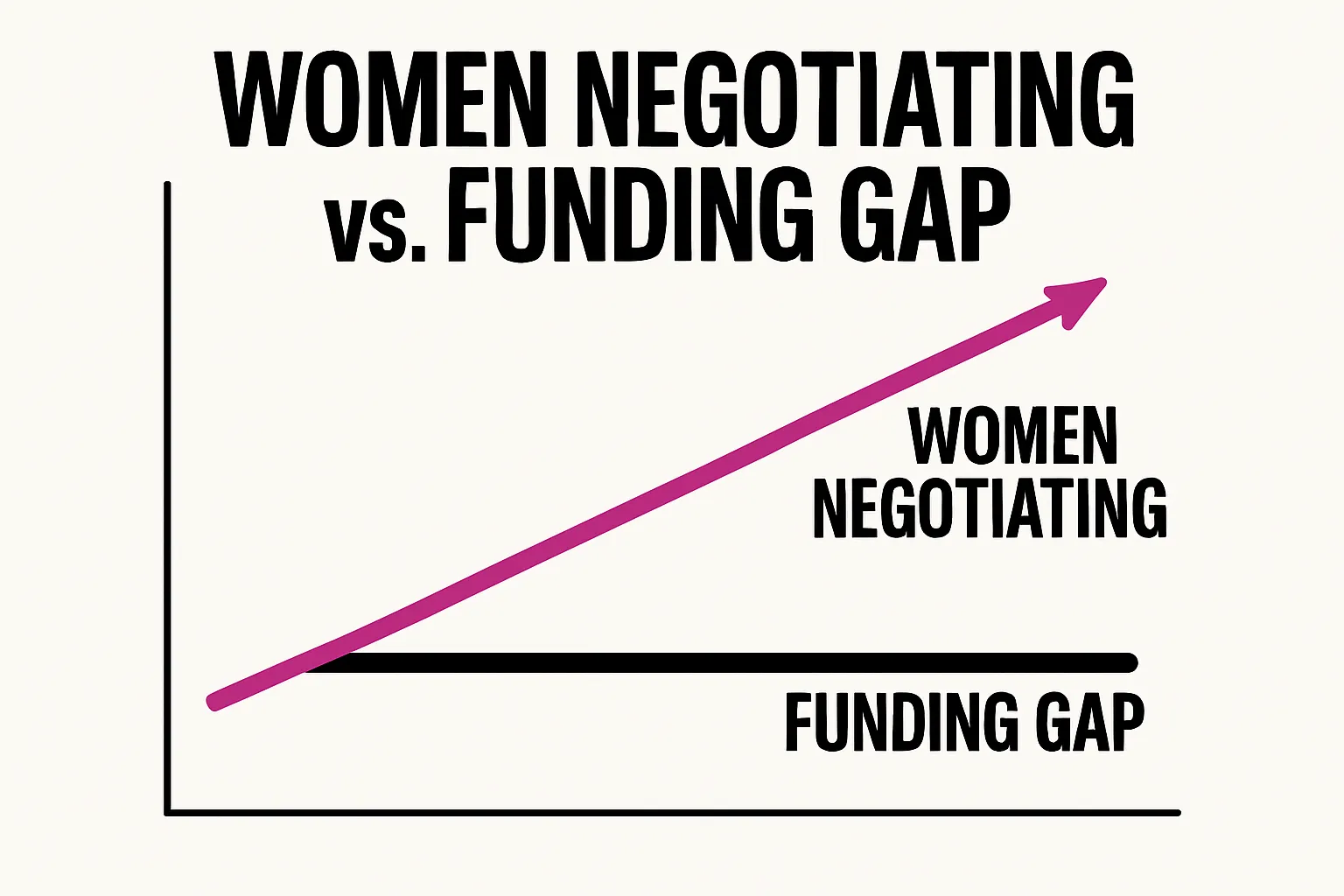
The latest research doesn’t just question the ask gap narrative. It demolishes it. Women are negotiating more than men now. The gap didn’t close because women got better at asking. The gap persists because the offers are worse — and no amount of asking fixes that.
“Just Ask for More” — The Advice That Won’t Die
The confidence gap story has a tidy origin. In the early 2000s, a wave of studies found that women initiated fewer negotiations than men. Linda Babcock and Sara Laschever’s Women Don’t Ask became a bestseller in 2003. The conclusion seemed obvious: if women would just ask, the gap would close. Teach women to negotiate, and equality follows.
The media ran with it. TED talks multiplied. A cottage industry of women’s negotiation coaching exploded. By 2013, Sheryl Sandberg’s Lean In cemented it as gospel: the problem is internal, and the solution is behavioral. Negotiate harder. Sit at the table. Raise your hand. The entire framing placed the burden of change on the person experiencing the disadvantage.
Publishers loved it. Conference organizers loved it. HR departments loved it. It sold books, filled workshops, and generated a decade of content that essentially said the same thing in different fonts.
Institutions loved it most of all. Because if the problem is women’s confidence, the solution is training women — not redesigning systems. If women are the broken part, you fix women. The bank doesn’t have to examine its own offer patterns. The VC firm doesn’t have to audit its term sheets. The underwriting model doesn’t need review. Convenient.
And it worked — as a narrative. Women internalized it. They went to the workshops. They practiced their power poses. They memorized their numbers. They asked for more.
The gap didn’t close.
Here’s what nobody wanted to say out loud: even when women followed the advice, the outcomes didn’t change. Women who negotiated aggressively didn’t close the gap. In many cases, they were penalized for trying. The advice wasn’t just ineffective — it was setting women up to be punished for doing exactly what they were told to do.
The Research That Blows It Up
The confidence gap narrative is dead. The data killed it. Here’s what the most recent peer-reviewed research actually says.
Women Are Now Negotiating More Than Men
A 2024 study in the Academy of Management Discoveries tracked negotiation behavior over two decades and found something the lean-in crowd didn’t expect: women now initiate salary negotiations more often than men. The trend reversed completely from the early 2000s data that launched the entire confidence gap industry.
Read that again. The foundational premise of the ask gap — that women don’t negotiate — is empirically false in 2026. Women ask. They ask often. They ask at higher rates than men. The gap remains.
If the problem were really about asking, we’d expect the gap to have closed as women started negotiating more. It didn’t. The gap in outcomes persisted even as the gap in negotiation behavior reversed. That’s not a confidence problem. That’s a system problem.
It Was Never About Confidence
A 2024 study published in the Journal of Economic Psychology (ScienceDirect) found that the mediating variable was never confidence. It was entitlements — what people believe constitutes a reasonable request.
Women and men assess their own qualifications similarly. They don’t differ in how competent they think they are. Where they differ is in what they believe the market will give them. Women expect lower offers because the market has consistently given them lower offers. This isn’t a confidence deficit. It’s an accurate read of a biased system.
The ask gap isn’t caused by women underestimating themselves. It’s caused by women accurately estimating a market that undervalues them.
Context, Not Character
Research from Harvard’s Program on Negotiation and Columbia University found that gender differences in negotiation outcomes are driven by structural context — who holds power, what’s being negotiated, what information is available — not by innate traits or personality differences.
In structured negotiations with clear rules and transparent information, the gender gap shrinks dramatically. In ambiguous, relationship-dependent negotiations — which describes most small business lending — the gap widens. The variable isn’t the woman. It’s the room she’s negotiating in.
This distinction matters enormously for business funding. Lending conversations are almost never structured. There’s no published playbook for what happens in the loan officer’s office. Rates are often discretionary. Product recommendations are subjective. Follow-up timelines are informal. This is exactly the type of environment where bias operates most freely — and where “just ask for more” is least effective.
Individual Fixes Don’t Work. Institutional Fixes Do.
A comprehensive 2025 review in Annual Reviews of Economics assessed decades of interventions aimed at closing gender gaps in negotiation. The conclusion was blunt: teaching women to negotiate better produces small, inconsistent effects. Changing institutional processes — salary transparency, structured offers, published criteria — reduces gender gaps by 40–60%.
The evidence is unambiguous. The problem is not the negotiator. The problem is the negotiation environment.
The Offer Gap: What’s Actually Happening
If the ask gap is a myth, what’s real? The offer gap. Women receive worse initial offers for the same products, the same services, the same loans — before they’ve said a word.
Lower Offers Before You Even Open Your Mouth
NCRC mystery shopping studies send matched pairs of testers — identical financial profiles, different demographics — into the same lending institutions. The results are not ambiguous.
Women were offered:
- Higher interest rates for loans of the same size and risk profile
- Smaller loan amounts than their financials warranted
- More collateral requirements than male testers with identical balance sheets
- Less information about available products, programs, and rates
This happened before any negotiation occurred. Before the woman opened her mouth, made a request, or demonstrated any negotiation behavior at all. The gap was baked into the first number the lender put on the table.
You cannot negotiate your way out of a gap that exists before the conversation starts. Not unless you know it’s there. And not unless you walk in with enough data to recognize that the offer you’re receiving is worse than what you’d get if you were someone else.
The Steering Problem
Steering is what happens when a loan officer guides you toward a smaller, safer product before you’ve stated what you want. It sounds like helpfulness: “Have you considered starting with a smaller line of credit?” or “For businesses at your stage, we usually recommend…”
It isn’t helpfulness. It’s pre-screening based on assumptions — assumptions that, research shows, correlate with gender and race, not with financial qualifications.
If you’ve ever walked into a bank asking about a $250,000 SBA loan and walked out with a brochure for a $25,000 microloan, you’ve experienced steering. If you want to understand the full pattern, read our breakdown of how to spot lending discrimination.
The Negotiation Penalty
Here is the cruelest part of the ask gap myth: women who follow the advice and negotiate aggressively face backlash that men don’t.
Studies consistently show that when men negotiate hard, they’re perceived as strong, confident, business-savvy. When women use the same tactics — same words, same tone, same ask — they’re perceived as difficult, aggressive, unlikeable. Evaluators penalize women for the exact behavior they reward in men.
This means the advice to “just negotiate harder” doesn’t just fail. It actively harms women who follow it, because the penalty for female assertiveness is real and measurable. The system tells women to ask for more, then punishes them when they do.
The Net Effect
Even when women ask for identical amounts, they receive less. The 2026 funding gap data makes this clear: women-owned businesses receive 32 cents for every dollar that goes to male-owned businesses. The gap isn’t because women aren’t asking. It’s because the offers, the terms, and the follow-through are systematically worse.
What This Actually Means for Your Next Funding Conversation
Let’s be clear about what this research does and doesn’t mean.
It does not mean you should stop negotiating. It means you should stop blaming yourself when negotiation alone doesn’t close the gap. Knowledge is leverage, and knowing the offer gap exists changes how you approach the table.
Here’s what works within a biased system:

1. Reframe the Ask Around Business Requirements
Research on the negotiation penalty shows that women face less backlash when they negotiate using business-requirement framing rather than personal-need framing.
- Instead of: “I need $300,000 to grow my business.”
- Say: “The business requires $300,000 based on these revenue projections, this market opportunity, and this growth timeline.”
The first framing makes it about you. The second makes it about the numbers. In a biased system, the numbers face less resistance than the person.
2. Always Get Competing Offers
This is non-negotiable. Multiple term sheets shift the power dynamic from “please approve me” to “I’m choosing between options.” It also gives you data — if one lender offers you $200,000 at 9% and another offers $200,000 at 7%, you know the first lender’s offer was bad, not your qualifications.
Our guide on how to negotiate your loan terms walks through this process step by step.
3. Anchor in Writing Before the Meeting
Anchoring research is clear: whoever puts a number on the table first sets the frame for the entire negotiation. Send a brief, professional email before your meeting that states the amount you’re seeking and the terms you expect.
Put it in writing. Written anchors are harder to dismiss than verbal ones. They create a documented baseline that the lender has to respond to — not a vague conversation they can steer wherever they want.
4. Choose Lenders With Structured Processes
The research on institutional fixes points directly to this: structured, transparent lending processes produce smaller gender gaps. Look for lenders who:
- Publish their rate sheets and fee schedules
- Use standardized criteria for loan decisions
- Provide written explanations for approvals, denials, and counter-offers
- Don’t rely on “relationship pricing” or subjective officer discretion
CDFIs and SBA-preferred lenders tend to have more structured processes than conventional banks. That structure is your friend.
5. Document Everything
If you suspect steering or discriminatory treatment, the paper trail matters. After every meeting, email the lender a summary: “Thank you for meeting today. To confirm, you mentioned [product X] at [rate Y] for [amount Z]. I’d also like to learn more about [larger product you weren’t told about].”
This creates a record. Records matter if you need to file a complaint, and they also signal to the lender that you’re informed and paying attention.
The Institutional Fix: What Actually Moves the Needle
Individual tactics matter. But the research is clear that the biggest gains come from fixing institutions, not coaching individuals.
What Transparency Does
Salary and loan term transparency policies reduce gender gaps by 40–60%, according to the Annual Reviews research. When everyone can see the criteria, the rates, and the outcomes, subjective bias has less room to operate.
This isn’t theoretical. States and countries that have implemented pay transparency laws have seen measurable, significant reductions in gender pay gaps. The same logic applies to lending.
What to Look For in a Lender
- Published criteria for loan approval — not “we evaluate each application individually” with no further detail
- Rate transparency — posted rate ranges by loan type and borrower profile
- No “relationship pricing” — opaque, officer-discretion pricing is where bias thrives
- Standardized processes — every applicant gets the same information, the same product menu, the same follow-up timeline
What to Demand From the System
This isn’t just about your next loan. It’s about every woman who walks into a lender’s office after you.
- Support lending transparency legislation. Bills requiring lenders to disclose aggregate data by gender and race are working their way through Congress. They need vocal support.
- Enforce fair lending laws. The Equal Credit Opportunity Act and the Community Reinvestment Act exist. Use them. File CFPB complaints when you experience discrimination. The complaint database is public and drives enforcement priorities.
- Push for structured lending processes. If you serve on advisory boards, chambers of commerce, or lender review panels, advocate for published criteria and rate transparency.
You don’t have to be an activist to do this. But if you’ve ever felt the offer gap personally, you already have the standing and the motivation. Use it.
The ask: hold institutions accountable, not just yourself.
Frequently Asked Questions
Is the ask gap completely debunked?
The original finding — that women negotiate less often than men — was accurate in the early 2000s. It is no longer accurate. The 2024 Academy of Management data shows women now negotiate more frequently than men. The outcomes gap persists, which proves the gap was never about asking frequency. It’s about what’s offered.
Does this mean negotiation doesn’t matter for women?
No. Negotiation still matters. But the framing needs to shift from “negotiate harder” to “negotiate smarter within a biased system.” Business-requirement framing, competing offers, written anchors, and lender selection are more effective strategies than simply asking for a bigger number.
How do I know if I’m experiencing the offer gap?
Compare. Get multiple offers for the same loan product. Ask other business owners — including men — what rates and terms they received for similar profiles. Use published rate data from the SBA and CDFI Fund as benchmarks. If your offers consistently come in worse than the published ranges for your risk profile, you’re likely seeing the offer gap in action.
The Bottom Line
The ask gap narrative was useful once. It got women to negotiate. It got the conversation started. But the firmware needs an update, because the premise was wrong.
You are not the problem. You are not under-asking. You are not lacking confidence. You are operating in a system that offers you less, steers you toward less, and penalizes you for pushing back — then tells you the gap is your fault.
The offer gap is the problem. And now you know it exists.
That knowledge changes everything. Not because it makes the system fair — it doesn’t. But because you stop wasting energy fixing something that isn’t broken (you) and start directing it at something that is (the offers, the processes, the institutions).
Negotiate — but negotiate knowing the game is rigged, and use that knowledge to play it differently. Get competing offers. Anchor in writing. Choose transparent lenders. Document everything. And when the system fails you, name it. Loudly.
Because the last thing this industry needs is another woman walking out of a lender’s office thinking she should have asked better.
She asked fine. The offer was the problem.