
If you’ve been planning your funding strategy around a grant program that targets women of color, a corporate initiative for underrepresented entrepreneurs, or a government contract set-aside — stop and read this first.
The landscape changed. Not slowly. Not subtly. Between the Fearless Fund settlement, a wave of anti-DEI executive orders, and a corporate pullback that’s still accelerating, the infrastructure for targeted funding programs looks materially different than it did 18 months ago.
This isn’t a political analysis. It’s a tactical briefing. Here’s what ended, what survived, what just changed its name — and what you should do about it.
What Happened — The 90-Second Version
The legal trigger: In 2023, the Supreme Court struck down race-conscious admissions in higher education. Conservative legal groups immediately turned that logic toward business funding programs. The American Alliance for Equal Rights — backed by Edward Blum, the strategist behind the admissions cases — sued the Fearless Fund, an Atlanta-based VC firm, over its Strivers Grant program that provided $20,000 grants exclusively to Black women entrepreneurs.
The settlement: Fearless Fund permanently closed the Strivers Grant to avoid a Supreme Court ruling that could have set precedent against all race-based business funding. Civil rights attorney Ben Crump called it a strategic retreat — protecting the broader legal framework by not giving the Court a case to rule on.
The executive action: Anti-DEI executive orders followed in 2025, with the Department of Justice committing to investigating programs that make decisions based on protected characteristics. As of early 2026, the DOJ is actively pursuing enforcement against programs and practices that use race as a factor in funding, hiring, or procurement.
The corporate pullback: Companies that funded targeted grants started restructuring:
- Progressive dropped the requirement that applicants be “Black and Latinx”
- PepsiCo removed the Hispanic descent requirement from food/beverage grants
- UBS moved its Black entrepreneur grant to a nonprofit administrator to reduce corporate legal exposure
- Multiple other corporate programs quietly broadened eligibility from race-specific to “underserved”
The pushback: Twenty states and the District of Columbia sued over USDA anti-DEI funding conditions. Civil rights organizations filed their own suits challenging the executive orders. The legal battle is far from settled — but the programs are already changing.
What Actually Ended vs. What Changed Its Name
This distinction matters. Not everything disappeared. Some things just got harder to find.
Programs That Closed Entirely
- Fearless Fund Strivers Grant ($20K to Black women entrepreneurs) — permanently ended
- Several corporate grant programs with explicit race-based eligibility — discontinued rather than legally defend
- Some accelerator cohorts designed for specific racial/ethnic groups — paused or eliminated
Programs That Restructured
This is the largest category, and the most confusing:
- Grants that broadened eligibility from “Black women entrepreneurs” to “underserved entrepreneurs” or “entrepreneurs in underrepresented communities”
- Same funding pools, wider applicant base, lower probability of award for the original target population
- Often the same organizations administering with different eligibility language
The practical impact: if you qualified before under a race-specific criterion, you still qualify — but now you’re competing with a larger pool. Your application needs to be stronger, not because you changed, but because the competition did.
Programs That Moved
UBS is the template here: move the grant from the corporate entity (legally exposed) to a nonprofit administrator (more protected). The money still flows, but through a structure that’s harder to challenge in court.
Watch for this pattern. Programs “ending” at a corporation may reappear at an affiliated foundation or nonprofit partner.
Programs That Are Untouched
This is the critical category for HerCapital’s readers:
Gender-based programs face lower legal risk than race-based programs. Under constitutional law, race-based classifications face “strict scrutiny” — the highest legal bar. Gender-based classifications face “intermediate scrutiny” — a lower standard that’s significantly easier to defend.
What this means practically: WOSB certification, women-focused SBA programs, women’s business centers, and gender-based grant programs are structurally more durable than race-based programs. They’re not immune to challenge, but they’re on firmer legal ground.
If you’re a woman of color, this matters: your gender-based access points are more stable than your race-based ones right now.
The Legal Line: What’s Actually at Risk

Not all targeted programs carry the same legal exposure:
Highest risk: Private grants or programs with explicit racial eligibility requirements → Subject to Section 1981 challenges (the Fearless Fund theory)
Moderate risk: Federal programs with race-conscious criteria → Subject to executive action and DOJ investigation, but also subject to congressional authorization that may provide legal cover
Lower risk: Gender-based programs (WOSB, women’s business centers, women-focused grants) → Intermediate scrutiny standard, stronger legal precedent supporting gender-conscious programs
Lowest risk: Place-based or income-based programs that correlate with demographic outcomes without naming them → “Underserved communities,” “low-income census tracts,” “rural entrepreneurs”
The Fearless Fund’s strategic decision to settle rather than litigate means the core legal question — whether Section 1981 prohibits race-conscious private grants — remains technically unanswered. The legal uncertainty itself is the chilling effect. Programs are closing not because courts have ruled them illegal, but because the risk of being the test case is too expensive.
Where the Money Actually Went
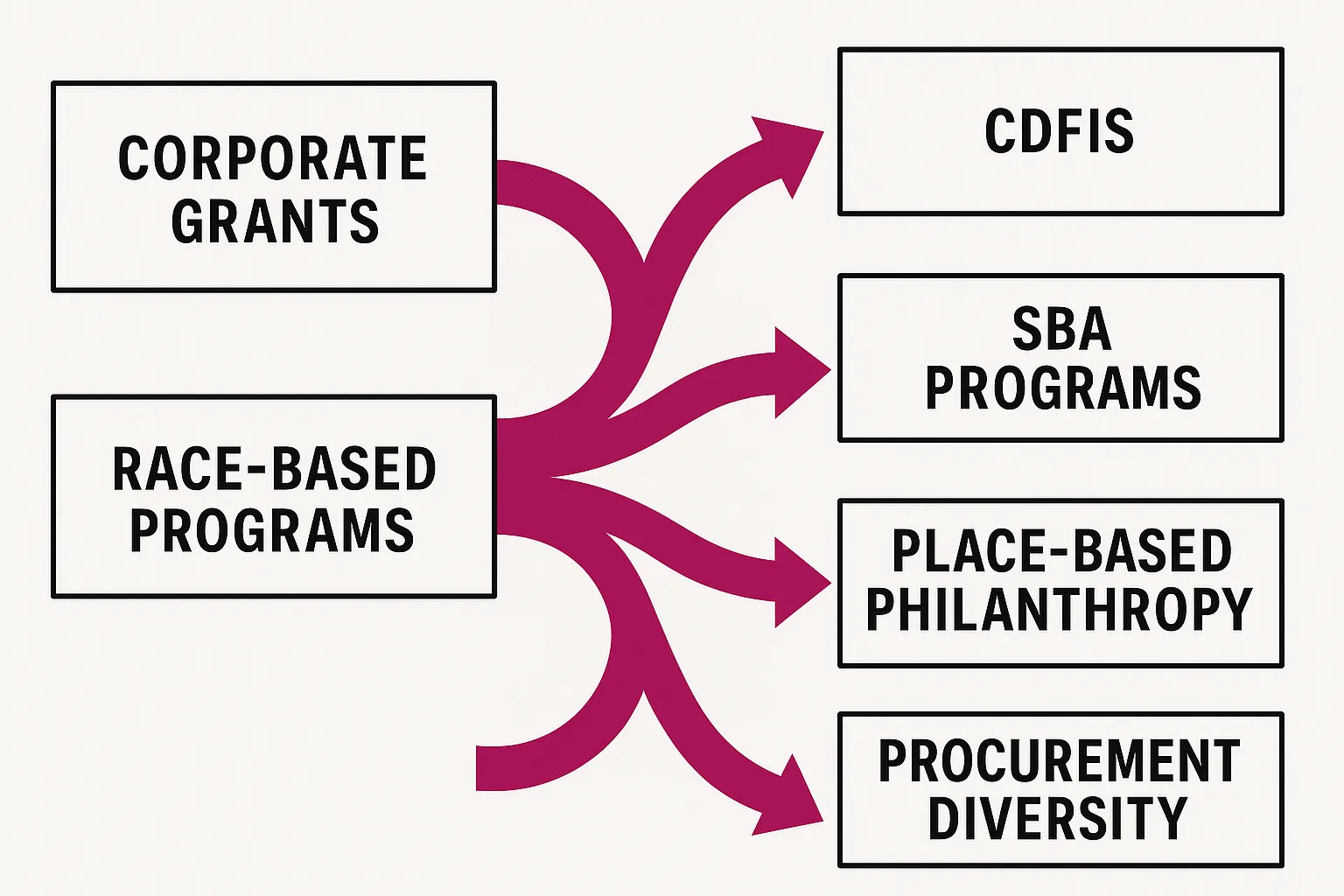
Capital doesn’t disappear. It redirects. Here’s where it’s flowing:
CDFIs: Structurally DEI Without Saying DEI
Community Development Financial Institutions are the most important capital channel for women of color right now. CDFIs are mission-driven lenders required to serve underserved communities — their entire structure does what targeted grants did, without using identity-based eligibility criteria.
- CDFIs disproportionately serve women and minority business owners by design — 59% of CDFI borrowers are people of color
- They’re not subject to the same legal challenges because their criteria are place-based and income-based
- They provide both capital and technical assistance
- They’re expanding, not contracting, in the current environment
SBA Infrastructure: Still Operational
The SBA’s women-focused programs remain active:
- Women’s Business Centers (100+ nationwide) — training, counseling, and capital access support
- SCORE mentoring — free business mentorship
- SBA 7(a) and 504 lending programs — no identity-based criteria, but WBCs help women navigate the process
- Government contracting set-asides for WOSBs — still legally intact
Philanthropy Pivot: Same Money, New Language
Private foundations are increasingly funding through criteria that correlate with demographic outcomes:
- “Place-based” grantmaking targeting specific geographic communities
- “Community-based” criteria focusing on census tracts with high minority business ownership
- “Ecosystem” investments in CDFIs and community lenders that serve diverse populations
- Procurement diversity programs — harder to challenge legally than grants, same economic impact
Corporate Pivot: From Grants to Procurement
Some companies replacing grants with supplier diversity commitments. This is significant: a corporate procurement contract is a business transaction, not a grant — and it’s much harder to challenge as discriminatory because the company is buying goods/services, not giving away money.
What to Do Right Now: A Tactical Checklist
1. Audit Your Funding Pipeline
If you were counting on a specific program, verify it still exists in its original form. Check:
- Is the program still active?
- Have eligibility criteria changed?
- Has administration moved to a different entity?
- Has the application deadline or process changed?
Don’t assume. Check.
2. Shift Weight From Grants to Lending
Grants are inherently more vulnerable to legal challenge than lending relationships. CDFIs, SBA microloans, and community-based lenders are structurally more stable capital sources. If grants were your primary strategy, diversify now.
3. Get WOSB Certified — Now
WOSB certification is more valuable now than at any point in the program’s history. Gender-based contracting set-asides remain legally intact while race-based programs face uncertainty. If you qualify and haven’t certified, the calculus just shifted decisively in favor of doing it.
4. Build CDFI Relationships
Don’t wait until you need capital to connect with a CDFI. CDFIs prioritize relationship lending — they want to know you before you need money. Find the CDFIs serving your area and industry, attend their workshops, open a conversation.
5. Document Everything
If you believe you’ve been denied funding, dropped from a program, or treated differently because of the political climate — document it. The legal landscape actually favors plaintiffs who can demonstrate discriminatory impact right now, because courts are simultaneously hearing challenges from both sides.
6. Follow the Money
When a program “ends,” ask where the funding went. Contact the administering organization. Check if a nonprofit affiliate launched a similar program with different eligibility language. The money often moves — it doesn’t vanish.
The Bigger Picture
Here’s what this moment actually is: a stress test. The funding infrastructure built on identity-based criteria is being legally challenged and politically pressured. Some of it will survive. Some will restructure. Some will disappear.
But the underlying capital need hasn’t changed. The funding gap for women of color is still $1.7 trillion globally. The demand is still there. The business performance data still shows women-founded companies delivering higher returns on lower investment.
The capital will flow. It’s already finding new channels. Your job is to know where those channels are — and to be positioned at the intake when they open.
Platforms like Lendesca connect women to community-based and mission-driven lenders across the spectrum — from CDFIs to SBA-facilitated digital lenders — precisely because the funding landscape requires navigation, not just application.
The map changed. This is the new one. Use it.