
Here’s a number that should change how you think about business: 54.4% of solopreneurs in the U.S. are women. Women are the majority of solo business creators — and in 2026, the tools available to a solo operator are unrecognizable from even two years ago.
A complete AI-powered business stack now costs between $3,000 and $12,000 per year. That’s a 95–98% reduction from what the equivalent human team would cost. One person with the right systems can now produce the output of a 5-person operation — in content creation, client management, bookkeeping, marketing, and operations.
This isn’t a tech-hype article. It’s a business finance piece. Because the way you run your operations directly determines whether a lender will fund your growth.
Why This Is a Funding Article, Not a Tech Article
Every lender evaluates the same fundamentals: revenue stability, margin health, and operational maturity. Here’s what AI-streamlined solo operations do to those metrics:
- Revenue per employee jumps dramatically when you’re the only employee and your output matches a team. A solo consultant generating $250K looks better to a lender than a 3-person consultancy generating $300K.
- Margins improve when you eliminate $40K–$80K in contractor and employee costs and replace them with $6K in software.
- Financial statements get cleaner when AI-powered bookkeeping categorizes transactions in real time instead of a shoebox receipt dump at tax time.
- Revenue becomes more predictable when automated marketing generates consistent lead flow instead of the feast-or-famine cycle of manual outreach.
A lender looking at your financial statements doesn’t care whether you have employees. They care whether the numbers are strong, consistent, and supported by systems that will keep working if you get sick for two weeks.
The solo founder penalty is real — lenders are more cautious about single-operator businesses. AI doesn’t just offset that penalty. Done right, it eliminates the reason the penalty exists.
The Five Systems Every Solo Business Needs (and What to Automate First)
Not every part of your business should be automated. But five operational areas — when systematized — transform a one-woman show into a scalable operation.
1. Client and Project Management
The manual version: Spreadsheets, sticky notes, email threads you can’t find, invoices you forgot to send.
The AI version: A CRM (HubSpot free tier, Dubsado, or HoneyBook) connected to your calendar and email. Client onboarding flows that trigger automatically. Project milestones that send status updates without you writing them. Invoice generation tied to project completion.
What this fixes financially: Faster invoicing means faster cash flow. Automated follow-ups on overdue invoices reduce your average days sales outstanding (DSO) — and lower DSO means better cash flow on your financials. One study found that automating accounts receivable can speed invoice cycles by up to 60%.
2. Bookkeeping and Financial Tracking
The manual version: Quarterly panic, a folder of receipts, and an accountant who asks you the same questions every year.
The AI version: QuickBooks or Wave connected to your business bank account and credit cards. Transactions auto-categorized by AI (accuracy is now above 90% for established patterns). Monthly P&L generated automatically. Cash flow forecasting dashboards that warn you before a crunch, not after.
What this fixes financially: Lenders want 2–3 years of clean, organized financial statements. AI bookkeeping produces them in real time. When you apply for an SBA loan or a CDFI term loan, the difference between “my books are up to date” and “give me a month to pull my numbers together” is often the difference between approval and denial.
3. Marketing and Lead Generation
The manual version: Posting on social media when you remember. A website that hasn’t been updated in months. No email list. No idea where your last five clients came from.
The AI version: A content calendar generated by AI (based on your niche, audience, and what’s performing), scheduled across platforms via Buffer or Later. Email sequences that nurture leads without you writing each message. SEO-optimized blog posts drafted by AI and edited by you (30 minutes vs. 4 hours per post). Analytics dashboards that show what’s actually driving revenue.
What this fixes financially: Consistent marketing generates consistent leads, which generates consistent revenue. Revenue consistency is the single most important factor in lending decisions after profitability. A lender looking at 12 months of steady $18K–$22K monthly revenue will fund you. The same lender looking at $8K one month and $35K the next will hesitate — even though the total is higher.
4. Operations and Workflows
The manual version: You do everything in the order it occurs to you. Every client engagement starts from scratch. Nothing is documented.
The AI version: Templated workflows in Notion or ClickUp. Standard operating procedures generated by AI from your descriptions of how you do things. Zapier or Make automations connecting your tools (new lead in CRM → welcome email → onboarding checklist → calendar invite → project created). Repeatable processes that produce consistent results whether you’re having a great day or a terrible one.
What this fixes financially: Operational maturity is what separates a freelancer from a business in a lender’s eyes. Documented processes, consistent service delivery, and automated quality checks signal that the business can function — even scale — without the owner doing everything manually. This directly addresses the solo founder penalty: you’re not a single point of failure if your systems work without you.
5. Administrative and Back-Office
The manual version: You’re the CEO, the accountant, the HR department, the legal team, and the receptionist. You spend 15 hours a week on tasks that don’t generate revenue.
The AI version: AI scheduling assistants (Reclaim.ai, Clockwise) that manage your calendar and protect deep-work blocks. AI-drafted contracts and proposals based on your templates. Automated expense tracking. AI-powered tax prep that categorizes deductions in real time. Virtual receptionists that handle intake calls.
What this fixes financially: Every hour spent on non-revenue admin is a dollar not earned. If your billable rate is $150/hour and you recover 10 hours/week from admin automation, that’s $78,000/year in capacity. You don’t have to fill all of it — but the capacity exists, and capacity is what lenders want to see.
The Stack: What It Costs and What It Replaces
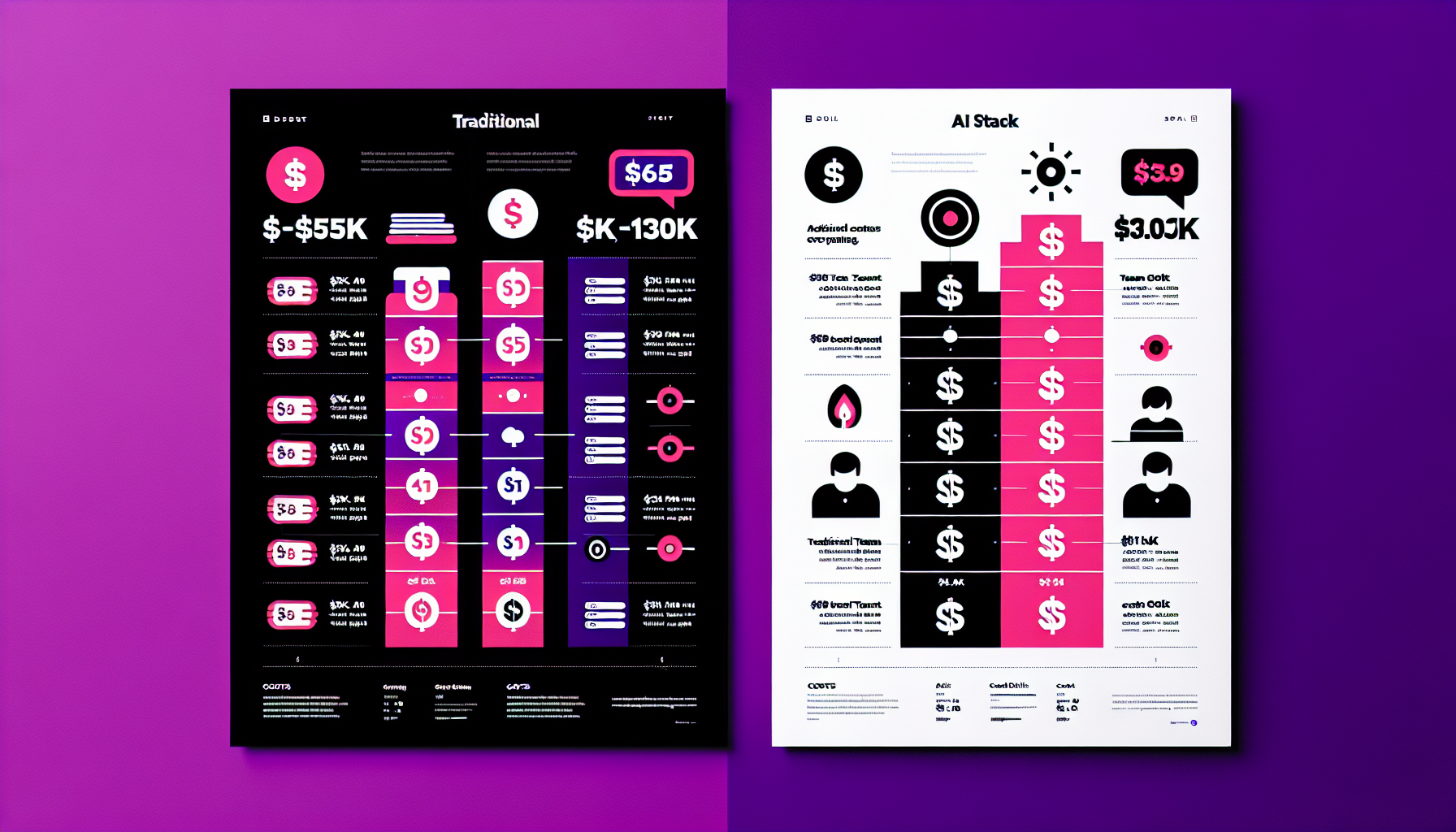
| Function | Tool Examples | Annual Cost | What It Replaces |
|---|---|---|---|
| CRM/client management | HubSpot Free, Dubsado | $0–$480 | Part-time admin ($8K–$15K/yr) |
| Bookkeeping | QuickBooks Self-Employed, Wave | $0–$360 | Bookkeeper ($3K–$8K/yr) |
| Marketing automation | Buffer, Mailchimp, Canva Pro | $300–$600 | Marketing contractor ($12K–$24K/yr) |
| AI writing/content | Claude, ChatGPT Plus, Jasper | $240–$600 | Content writer ($6K–$18K/yr) |
| Workflow automation | Zapier, Make | $240–$600 | Operations manager ($30K–$50K/yr) |
| Scheduling/admin | Reclaim.ai, Calendly Pro | $96–$240 | Virtual assistant ($6K–$15K/yr) |
| Total | $876–$2,880 | $65K–$130K/yr in human costs |
Even the premium version of this stack — adding paid tiers, more advanced tools, and AI agent subscriptions — rarely exceeds $12,000/year. Compare that to the $65,000–$130,000 you’d spend on the equivalent human team.
What Lenders See When Your Operations Are AI-Streamlined

When you walk into a lending meeting with an AI-powered solo business, your financials tell a specific story:
- High gross margins. Low overhead means more of each dollar stays in the business. A service business running at 70%+ gross margin signals health.
- Consistent monthly revenue. Automated marketing and systematic client management produce repeatable revenue patterns. No feast-or-famine.
- Clean, current financials. AI bookkeeping means your P&L is never more than 24 hours old. When the loan officer asks for your YTD financials, you can pull them on your phone.
- Low fixed costs. Your breakeven point is low enough that a single bad month won’t create a debt service coverage problem.
- Scalability. The systems are in place to grow revenue without proportional cost increases. A lender sees a business that can profitably absorb the loan payment because growth doesn’t require equivalent spending.
Compare this to the typical solo business financial profile lenders see: inconsistent revenue, outdated books, high overhead relative to revenue, and no documented systems. That profile triggers every risk flag in underwriting.
Common Mistakes to Avoid
Don’t automate what you haven’t done manually first. If you’ve never sent a marketing email, don’t start with a 12-email automated sequence. Do it manually 10 times. Understand what works. Then automate the version that works.
Don’t use AI to replace thinking. AI drafts your proposals — you review every word before it goes to a client. AI categorizes your expenses — you review the categorization monthly. AI generates your social content — you add your actual experience and point of view. The businesses that get in trouble with AI are the ones that stop paying attention.
Don’t stack tools you don’t use. A $200/month tool subscription budget is reasonable. A $200/month tool subscription budget where you actually use 3 of the 8 tools is waste. Start with two tools: a CRM and a bookkeeping platform. Add from there based on actual bottlenecks, not productivity influencer recommendations.
Don’t hide the solo. Some women feel pressure to make their business look bigger than it is — fake team pages, plural “we” language, virtual office addresses. Lenders see through this, and it damages trust. Own the solo model. Frame it as a deliberate business strategy with systems supporting it — because that’s what it is.
The Solopreneur Funding Advantage
Here’s what nobody tells you: a well-run solo business can actually be more fundable than a small team.
- No payroll obligations competing with debt service payments
- Higher margins mean better debt service coverage ratios
- Lower breakeven means lower risk for the lender
- Owner commitment is total — there’s no agency problem
The solo founder penalty exists because lenders worry about key-person risk. AI systems are the answer to that worry. Your business insurance covers the personal risk. Your documented, automated operations cover the business risk.
When you sit down with a lender and explain: “I generate $180,000 in annual revenue with $12,000 in operating costs, automated bookkeeping, a documented client pipeline, and systems that would allow a contractor to step in if I were unavailable” — that’s not a risky solo business. That’s a machine.
Lendesca can help you compare how different lenders evaluate solo business applications — from SBA lenders who weight revenue consistency to online lenders who prioritize margin health — so you apply where your AI-optimized financials are strongest.
Start This Week
You don’t need to build the entire stack at once. Start with the two systems that have the highest financial impact:
- Automated bookkeeping. Connect QuickBooks or Wave to your business bank account today. In 30 days, you’ll have a clean P&L for the first time.
- CRM with invoicing. Move your client tracking out of your inbox and into a system that sends invoices automatically. Your DSO will drop within 60 days.
Once those two are running, add marketing automation (month 2) and workflow templates (month 3). By month 4, you’ll be running a fundamentally different business — same you, same clients, same revenue, but with the operational maturity that makes lenders say yes.
The tools exist. The cost is negligible. The only question is whether you’ll build the systems or keep being the system.
Related reading on HerCapital:
- The Solo Founder Penalty: Why Going It Alone Costs Women More — and How to Offset It
- AI-Powered Funding Applications: How to Use AI to Get Your Grant, Loan, or Pitch Over the Line
- Bootstrapping Your Way to Growth: The Self-Funding Playbook
- Build Your Business Credit Before You Need It
- Financial Statements That Make Lenders Say Yes