
What happens to your business if you can’t show up tomorrow?
Not “what if you want to sell someday.” Not “what’s your five-year exit plan.” What happens tomorrow — if you get sick, get hurt, burn out, or simply decide you’re done?
Forty percent of business owners have no succession plan at all. Fewer than 20% have comprehensive plans, according to the Exit Planning Institute. And among those 12 million baby boomer business owners expected to exit in the next decade — representing over $10 trillion in value — the vast majority will try to figure out succession while it’s already happening.
For women founders, the stakes are different. Your business may be your retirement plan. Your identity may be wrapped in it more tightly than you realize. And if you’ve built something that advances women’s economic power — or serves a community that depends on you — letting it collapse isn’t just a personal loss. It’s a structural one.
Succession planning isn’t about leaving. It’s about making sure what you built survives.
Why Women Founders Avoid This Conversation
Let’s name the reasons, because they’re real:
- “The business IS me.” When you’ve built something from nothing — often over years, often through systems that explicitly worked against you — separating yourself from the business feels impossible. The brand is your reputation. The clients trust you specifically. The vision is yours.
- “I’m not done yet.” Succession planning feels like admitting you’re on the way out. It’s not. It’s acknowledging that a business with a succession plan is worth more, lasts longer, and gives you options — whether you use them in 2 years or 20.
- “I don’t have anyone to hand it to.” The most common succession option — a child taking over — works for 45% of business owners who have that option. The rest assume succession means finding a specific person. It doesn’t. It means building a business that can transfer to anyone.
- “I can’t afford to think about this right now.” You can’t afford not to. A business without a succession plan is worth 30–50% less than one with documented, transferable operations. That discount applies whether you sell, transfer, or have the business appraised for lending purposes.
Succession Planning vs. Exit Planning: They’re Not the Same
The exit readiness playbook on HerCapital covers building a business worth selling — maximizing value for a transaction. That’s exit planning.
Succession planning is broader. It answers: who operates this business when you don’t?
| Exit Planning | Succession Planning | |
|---|---|---|
| Goal | Maximize sale price | Ensure continuity |
| Timeline | 3–5 years before sale | Start now, ongoing |
| Trigger | You decide to sell | Anything: retirement, illness, burnout, death, new opportunity |
| Focus | Financial value | Operational transfer |
| Outcome | Cash at closing | Business continues |
You need both. But succession planning comes first, because it protects you during the years before an exit — and because the business that has a succession plan is the business that gets the best exit price.
The Four Succession Paths (and Which One Fits)
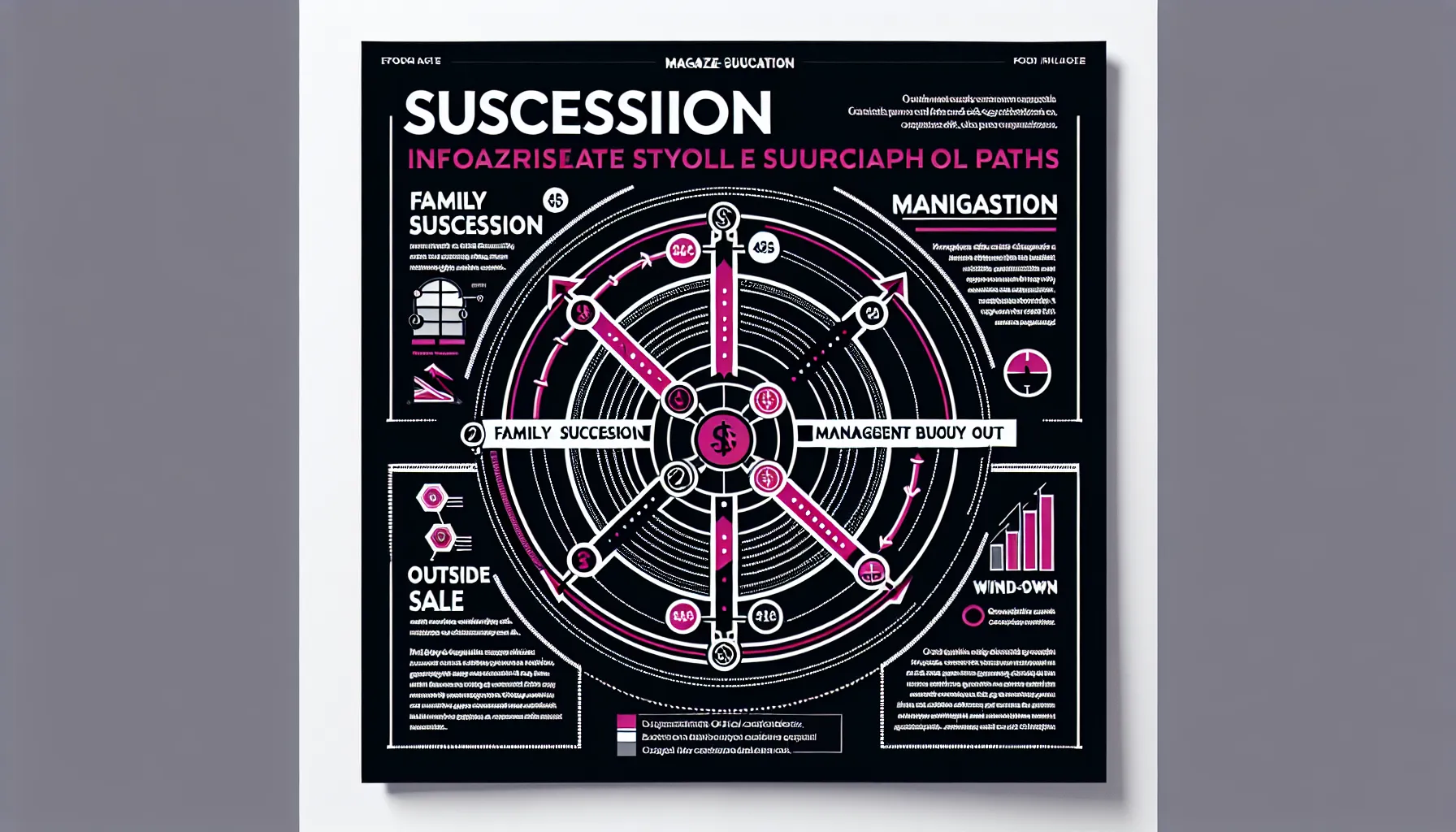
Path 1: Family Succession
A family member — usually a child or sibling — takes over operations and eventually ownership.
When it works: When the family member is genuinely interested, has relevant skills, and has had time to learn the business from the inside. This is not “my daughter can figure it out.”
What to prepare:
- Start the transition 5–7 years before handoff
- Define roles incrementally — decision-making authority, client relationships, financial oversight
- Formalize the transfer structure: gift, sale at below-market, installment sale, or trust
- Address the tax implications early. Gifting shares up to the annual exclusion ($18,000 per recipient in 2026) or using your lifetime exemption reduces estate tax exposure. An installment sale provides you income while transferring ownership gradually.
- Create a buy-sell agreement even within the family — it prevents disputes
The gender dimension: Only 28% of boomer-business transfer value is projected to go to women and Black/Latino individuals combined. If preserving female ownership matters to you — and for many women founders, it does — family succession planning should explicitly address this.
Path 2: Management Buyout
Your existing team — a key employee, operations manager, or general manager — buys the business from you.
When it works: When you have at least one person who already runs significant operations, knows the clients, and has or can access financing. SBA 7(a) loans are the primary vehicle for management buyouts — $8.8 billion in acquisition loans were issued in FY2025, a 31% increase year-over-year.
What to prepare:
- Identify the successor 3–5 years before transition
- Progressively delegate decision-making authority and client relationships
- Create a training plan that covers everything you do that nobody else does
- Structure the deal: lump-sum purchase, earnout (portion of price tied to future performance), or seller financing (you carry a note — you become the bank)
- Consider an ESOP (Employee Stock Ownership Plan) if you have multiple key employees — the tax advantages can be significant
Path 3: Outside Sale
You sell the business to an external buyer — another entrepreneur, a competitor, or a private equity firm.
When it works: When no internal successor exists or when you want a clean break. The exit readiness playbook covers how to maximize value here.
What succession planning adds to this path:
- Documented SOPs and systems that prove the business works without you
- A management team or key employees who will stay through the transition (buyer’s biggest fear is that key people leave)
- Clean financial records going back 3–5 years
- Client contracts and relationships that transfer with the business, not with you personally
- Business insurance that covers the transition period
Path 4: Wind-Down With Dignity
Sometimes the right succession plan is an orderly closure. Not every business should outlive its founder — especially solo practices, creative businesses, and highly personal service providers.
When it works: When the business has no transferable value beyond you, and you’d rather close well than sell for pennies.
What to prepare:
- Timeline: 6–12 months minimum
- Client transition plan: referrals to trusted providers, project completion commitments
- Contract obligations: complete or negotiate exits from remaining commitments
- Asset liquidation: equipment, inventory, IP, domain names
- Financial wrap-up: final tax filing, liability settlement, business credit closure
- Emotional preparation: this is a legitimate, honorable outcome. Not every business needs to live forever.
The Documents You Need (and When to Create Them)

Year 1 — Create these now:
- Key-person insurance policy. If you died tomorrow, does the business have enough cash to survive 6–12 months while someone figures out what to do? Key-person life insurance covers that gap. Cost: typically $500–$2,000/year for $250K–$500K in coverage, depending on your age and health. This connects directly to the business insurance planning most women skip.
- Emergency operations document. A single document — updated quarterly — that contains: login credentials for every business system, key contact information (clients, vendors, attorney, accountant, banker), instructions for the first 48 hours if you can’t work. Give a trusted person access to this document. Not your business partner — someone outside the business who can act as an executor.
- Buy-sell agreement. Even if you have no partners, a buy-sell agreement pre-defines what happens to your ownership interest upon death, disability, or departure. It can name a buyer, set a valuation method, and fund the purchase through insurance. Your attorney should draft this; it typically costs $2,000–$5,000.
Year 2–3 — Build these:
- Standard operating procedures. Document every repeatable process in your business. Client onboarding, service delivery, invoicing, marketing, vendor management. Not for you — for the person who will need to do your job without you.
- Successor identification. Whether it’s a family member, employee, or characteristics of your ideal buyer, put it in writing. Include: what skills they need, what knowledge transfer is required, what timeline the transition requires.
- Financial projections without you. Work with your accountant to model the business’s performance under different succession scenarios. What does revenue look like if you step back to advisory in year 1? Part-time in year 2? Fully out in year 3? These projections aren’t just for planning — they make the business more valuable to any buyer or lender.
Year 3–5 — Execute:
- Begin the transition. Whatever path you’ve chosen — family, management buyout, outside sale, wind-down — start the actual handoff. Introduce the successor to key clients. Transfer decision-making authority. Step back from daily operations.
- Legal structure transfer. Work with your attorney and accountant on the tax-optimal transfer method: outright sale, installment sale, gift with retained interest, GRAT, ESOP, or merger.
- Update your personal financial plan. Your retirement strategy changes fundamentally once the business succession is underway. The business proceeds, ongoing payments, or reduced salary need to be integrated into your personal wealth plan.
The Tax Implications Nobody Warns You About
Succession planning without tax planning is leaving money on the table. Here are the structures that matter:
- Installment sale: Spread the capital gains tax over the payment period instead of paying it all in the year of sale. If your business sells for $800K, the difference between paying taxes on $800K in one year vs. $160K/year over five years can be six figures in tax savings.
- Gifting shares over time: The 2026 annual gift exclusion is $18,000 per recipient. If you have three children, you can transfer $54,000 in business value per year with zero gift tax. Over 10 years, that’s $540,000 transferred tax-free.
- Grantor Retained Annuity Trust (GRAT): Transfer business ownership to a trust while retaining an annuity payment. When structured correctly, the business growth transfers to your beneficiaries free of gift and estate tax. Works best when the business is growing faster than the IRS interest rate.
- ESOP: Sell to an Employee Stock Ownership Plan and defer capital gains tax by reinvesting in qualified replacement property (Section 1042 rollover). The business becomes employee-owned, the seller gets tax deferral, and the employees get ownership — everyone wins.
- Section 1202 QSBS exclusion: If your business is a qualifying C-corp and you’ve held the stock for 5+ years, you may exclude up to $10 million (or 10x your basis) in capital gains from federal tax. This is the most valuable tax provision most small business owners don’t know about.
Connect this to the 2026 tax playbook for the full picture on maximizing deductions during the succession transition.
Lendesca can help you understand how succession planning affects your current lending options — and how different transfer structures impact the business’s creditworthiness during transition. Planning your succession doesn’t have to mean losing access to growth capital.
What Happens If You Do Nothing
This is the part nobody says out loud.
If you have no succession plan and something happens to you:
- Your family inherits a business they can’t run, with clients who leave within 90 days
- The business value — which might be $200K, $500K, $2M — drops to liquidation value (typically 10–20% of going-concern value)
- Your employees lose their jobs with no transition period
- Your clients scramble to find replacement providers
- Any business debt becomes a personal estate obligation
- Everything you built disappears in months
This isn’t pessimism. It’s actuarial reality. It happens to thousands of businesses every year. The only difference between the businesses that survive their founders and the ones that don’t is planning.
Start Today. Not Next Quarter. Today.
You don’t need to have all the answers. You need to start asking the questions.
This week:
- Write down the name of the person you’d call if you couldn’t work for the next 3 months. If no name comes to mind, that’s your first problem to solve.
- Check whether you have key-person life insurance. If not, get a quote. It takes 15 minutes online.
- Create the emergency operations document. Start with login credentials and key contacts. You can build from there.
This month:
- Have a conversation with your accountant about succession tax implications
- Talk to your attorney about a buy-sell agreement
- Start documenting your most critical business processes
This quarter:
- Identify your preferred succession path
- Begin modeling the financial transition
- If your path involves a specific person, start the conversation with them
Your business is your legacy. The question isn’t whether you’ll leave it someday. The question is whether it’ll still be standing when you do.
Related reading on HerCapital:
- Building a Business Worth Selling: The Exit Readiness Playbook
- The Retirement Trap: Why Women Entrepreneurs Build Wealth for Everyone but Themselves
- The Insurance Blind Spot: Why Women-Owned Businesses Are Underprotected
- The Partner Buyout Playbook: How to Finance Getting Out — or Getting Your Partner Out
- The 2026 Tax Playbook: What Every Woman Business Owner Needs to Claim