
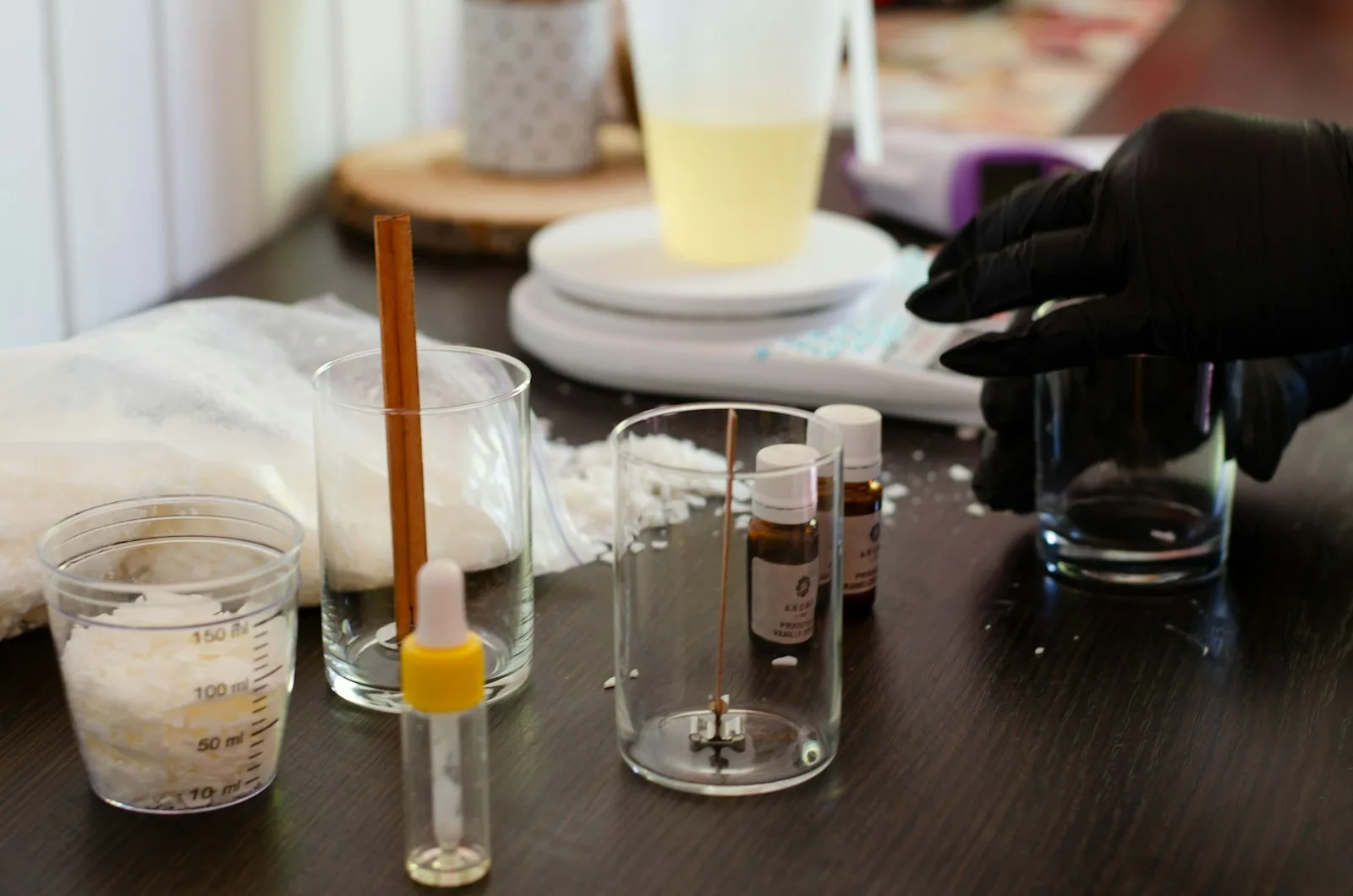
In the summer of 2021, Destiny Harper was formulating skincare at her kitchen table in Detroit, one hand-whipped batch at a time. A $200 bulk order of unrefined shea butter sat next to jojoba, tamanu, and a digital kitchen scale she’d bought for $19 on sale.
She wanted to build a real company. Every person she talked to — the SCORE counselor, the retail consultant, the founder of a skincare brand she admired — told her the same thing: she needed $75,000 to get off the ground. A lab. A co-packer. A branding agency. A PR retainer.
Harper didn’t have $75,000. She had $3,400 in savings, a credit score of 642, and a spreadsheet she kept editing at midnight.
“Everyone talked about the number I didn’t have. Nobody asked what I could do with the number I did.” — Destiny Harper
What she did eventually have was $15,000, sourced through a Kiva microloan in early 2022. Four years later, Harper Made Goods is a small-batch skincare and body care brand stocked in 40-plus independent boutiques and several regional Whole Foods stores. 2025 revenue closed at roughly $680,000. She employs four part-time staff. She has taken zero outside equity.
This is the story of how $15,000 — deployed with discipline — became a company.
What the Banks Said
Before the microloan, Harper did what most first-time founders are told to do. She walked into banks.
In October 2021, she applied for a $35,000 small business loan at the regional bank where she’d held a personal checking account since 2017. The rejection letter cited two issues: insufficient revenue history (Harper Made Goods had been an LLC for four months and had booked $0 in sales) and a personal credit score below the bank’s minimum threshold of 680.
She was at 642. She was 38 points short of a conversation.
A month later, she tried a second bank — a national one with a “small business” marketing push running on Instagram. This time she brought a business plan, a sample product, a projected P&L, and letters of intent from two boutique buyers. The rejection came faster. The bank’s underwriter flagged the business as “pre-revenue with unestablished owner credit.”
She also applied for a $5,000 business credit card. Denied.
“The message was consistent. The system was not designed to evaluate what I was building. It was designed to evaluate what I already had.” — Destiny Harper
The loan denial playbook walks through exactly this pattern: rejections based on thresholds that correlate with pre-existing wealth and credit access, not on business viability. Harper didn’t have the vocabulary for it at the time. She just knew she was getting nowhere.
The Microloan Nobody Mentioned
The word “microloan” came up almost by accident.
In December 2021, Harper attended a free business clinic hosted by ProsperUs Detroit, a local CDFI-affiliated lender that runs small business counseling in the city. Her counselor — a former commercial banker named Patrice — asked Harper how much capital she actually needed to produce a first real run of product and get it into stores.
Harper had the answer ready. She’d been rehearsing it for weeks. Fifteen thousand dollars.
“Then stop applying for $35,000 loans,” Patrice told her. “You’re overshooting into a category banks won’t underwrite for a brand-new business. Look at microloans.”
Harper went home and spent four nights reading about Kiva, Accion Opportunity Fund, Grameen America, and the SBA microloan program. Kiva’s model stopped her cold: 0% interest, no fees, funded by peer lenders in $25 increments, and — critically — no credit score minimum. The gate was a “social underwriting” step where she had to get 15 people in her network to lend $25 each before the public campaign opened.
It was a model built for exactly her situation: a founder the banks had classified as too small, too new, too risky.
She applied in January 2022. Her campaign funded in nineteen days.
The $15K Plan
Harper’s Kiva application included a line-item budget she’d built and rebuilt across dozens of drafts. It looked like this:
- Lab formulation and stability testing: $3,200
- Packaging design and first print run: $2,800
- Initial inventory — 1,500 units across 4 SKUs: $5,500
- Shopify setup, email marketing, and cold-outreach tools: $500
- Operating buffer: $3,000
Total: $15,000.
Every number was defended in a one-page appendix. The formulation cost came from two actual quotes — one from a cosmetic chemist in Chicago, one from a Detroit-based lab she’d visited. The inventory cost was built from raw-material sheets and a per-unit COGS calculation of $3.67. The buffer was calculated as eight weeks of minimum operating expense.
Harper believes the precision of that budget was the single most important asset in her application.
“Microloans aren’t a handout. They’re a bet. The lenders backing my campaign wanted to see that I’d already done the math on their money before they gave it to me.” — Destiny Harper
That same discipline — knowing what you need and what you don’t — is what separates founders who scale microcapital from founders who burn it. It’s also the discipline that makes the difference when it’s time to pursue a small-business grant strategy or larger debt later.
The First 12 Months
The money hit her business account in February 2022. Harper moved fast, but not carelessly.
She finalized four SKUs — a shea body butter, a facial oil, a whipped cleanser, and a lip balm — by April. Packaging landed in May. Her first 1,500 units went to a co-manufacturing partner for fill and finish and came back labeled in early June.
The first retail pitch she landed was a neighborhood boutique in Midtown Detroit that took 60 units on consignment. It was not glamorous. It was a start. Six weeks later, the boutique reordered at wholesale. Four weeks after that, a second boutique in Ferndale placed an opening order of 120 units.
In October 2022, a buyer from a regional Whole Foods cluster emailed her after seeing Harper Made Goods on a gift guide run by a local magazine. The email was three sentences long. Harper read it twelve times before responding.
By the end of year one, she had booked $94,000 in revenue across DTC and wholesale. Gross margin was 58%. She had 12 retail stockists. She still worked from a production space she rented by the hour.

The Reinvestment Discipline
Harper set a rule before the loan even funded: every dollar of profit would go back into the business for 18 months. No personal salary draws above $1,800 a month. No new car. No office.
She held the line.
For the first eighteen months, she paid herself $1,800 monthly and routed everything else into inventory, a part-time operations hire, and a modest paid-media budget. She also paid Kiva back on schedule — her 36-month repayment came in at roughly $420 per month, a line item she treated as sacred.
“When you have a small amount of money, you can’t let any of it do nothing. Every dollar had to either produce product, move product, or protect the business.” — Destiny Harper
This is the part of the story that rarely gets posted. Reinvestment discipline is not a slogan. It’s the unglamorous engine of small-capital businesses — and it is the part most first-time founders violate within six months.
Why Small Capital Worked
There’s a popular belief — repeated in accelerator decks and founder podcasts — that a business needs to “scale” to matter. The framing has a cost. Founders raise too much, spend too fast, and build cost structures their revenue can’t carry.
Harper’s experience points the other direction.
When you have $15,000 instead of $75,000, you pick your first four SKUs with care, because you cannot afford a dud. You choose your first five retailers deliberately, because you can’t flood the market. You build your customer list one email at a time, because there’s no paid-media budget to buy scale.
Constraint is not a disadvantage in the early years. It’s a filter.
The CDFI guide explains how mission-driven lenders like Kiva, Accion, and their CDFI peers are specifically built for this early stage — small capital, tight underwriting, relationship-driven. These are not consolation-prize lenders. For many founders, they are the right first lender, full stop.
What Comes Next
By late 2025, Harper Made Goods had outgrown the microloan bracket. Revenue was comfortably over half a million, margins were stable, and the product line had expanded to seven SKUs. Harper had started getting emails she’d never expected — a pitch from a national retailer requesting a category meeting, a sourcing inquiry from a European distributor, a cold outreach from a skincare-focused investor.
She is now evaluating a $75,000–$150,000 CDFI loan to underwrite a larger production run and a permanent production space. She’s also looking at an SBA microloan, which caps at $50,000 but carries favorable terms for established minority-owned businesses.
When she was ready to scale beyond microloans, she began evaluating alternative funding partners like Lendesca, which helps founders map available debt products — CDFI, SBA microloan, SBA 7(a), revenue-based financing — against their actual revenue profile and capital needs. For a founder who spent 2022 learning that the wrong loan product is a faster path to failure than no loan at all, that kind of map matters.
She has not taken an equity meeting. She does not plan to.
What She’d Tell Another Founder
Harper has been asked to speak at three business schools and two founder summits in the last year. Her talking points are tactical, not inspirational.
- Size your ask to the product you actually need. Banks reject applications that don’t match the underwriter’s category. If you need $15,000, don’t apply for $50,000 because someone told you “ask for more.” Apply for the category your business actually fits.
- Build your credit before you need the loan. Harper’s 642 wasn’t a life sentence, but it closed doors. Building business credit — and personal credit — is a 12-to-24-month project. Start now.
- Know your COGS per unit to the penny. Microloan lenders, grant reviewers, and CDFI underwriters will test this number. If you can’t defend it, you will lose to a founder who can.
- The first retailer is not your biggest retailer. Harper’s first wholesale account was 60 units on consignment. Treat small first wins as proof, not ceiling.
- Pay yourself last, not never. There is a difference between disciplined reinvestment and unsustainable founder martyrdom. Harper set a $1,800 floor and held it. She did not set $0.
For founders looking to study similar paths, we’ve profiled more founder stories across lending types, industries, and stages.
A Closing Data Point
Kiva reports that women-founder repayment rates across its U.S. microloan program exceed 97% — one of the highest repayment rates of any lending product in the country. The CDFI Fund, which certifies and capitalizes community lenders, reports that CDFIs collectively extended over $30 billion in lending last year, with women-owned businesses representing a growing share of portfolio volume.
The capital is there. It is smaller, slower, and more relational than a bank term loan. For the right founder at the right stage, that is a feature, not a bug.
Harper is proof.
Harper Made Goods is based in Detroit, Michigan. Destiny Harper is a composite founder profile created to illustrate real microloan lending outcomes for women-owned small businesses. All financial figures and timelines are representative of documented microloan and CDFI lending experiences.
Additional resources: Kiva · Accion Opportunity Fund · SBA Microloan Program · CDFI Fund · Grameen America