
You don’t have to build a customer base from scratch. You don’t have to spend three years chasing breakeven. You don’t have to prove a concept that someone else already proved — and sold profitably for 15 years.
Acquisition is a different path. You buy a business that already works, already has customers, already has employees, and already generates cash. Then you run it better. That’s the pitch, and the math usually holds up.
More women are figuring this out. But the financing side — the part that determines whether you can actually close a deal — has real obstacles that don’t get talked about enough. This guide covers both: how acquisition financing works, and how to navigate it when the system wasn’t built with you in mind.
Why More Women Are Buying Businesses Instead of Building Them
The startup path is romanticized beyond recognition. The reality: most startups fail within five years, and the early years are a cash-burning exercise in market validation — work that a previous owner already did for you.
Acquisition flips that math. You’re buying proven revenue, an existing customer base, trained employees, and operational systems. The business has a track record you can underwrite. The risk profile looks completely different from a lender’s perspective, which is why SBA acquisition financing exists at all.
Women are the fastest-growing demographic in business acquisitions. The numbers are moving. But the financing headwinds are real and documented: women receive smaller SBA acquisition loans on average and face higher denial rates than men with comparable credit profiles and business experience. This isn’t a perception problem. SBA lending data has shown persistent gaps in approval rates and loan amounts across gender lines, even controlling for credit score and collateral.
Framing matters here: buying a business is fundamentally a financing decision. The business you can acquire depends entirely on the financing you can secure. And every financing decision carries a gender dimension — whether lenders acknowledge that openly or not.
Understanding The Funding Playbook before you start shopping for businesses will save you months of wasted time and rejected applications. Know your financing ceiling before you fall in love with a target.
What You Can Actually Buy (And What You Can Afford)
Business Valuation Basics
Sellers use two primary valuation frameworks depending on deal size:
- SDE (Seller’s Discretionary Earnings) multiples — used for businesses under $1M in purchase price. SDE is net profit plus owner compensation plus any one-time or non-essential expenses the owner ran through the business. Typical multiples run 2–4x SDE depending on industry, growth trend, and transferability.
- EBITDA multiples — used for larger businesses ($1M+ purchase price). Earnings before interest, taxes, depreciation, and amortization. Multiples vary widely by industry — service businesses often trade at 3–5x EBITDA; more asset-heavy or high-growth businesses trade higher.
The individual buyer sweet spot: $100K–$2M in purchase price. Below $100K, you’re often buying a job with no real infrastructure. Above $2M, you’re competing with private equity, and the debt load gets heavy without institutional backing. The $250K–$800K range is particularly strong for first-time acquirers — enough business to be real, small enough that a motivated seller still needs an individual buyer.
Industries Where Women Buyers Are Succeeding
Some sectors have better dynamics for women acquirers — either because sellers are more receptive, the workforce is predominantly female (easing transition), or financing approval rates are stronger:
- Healthcare services — home health agencies, physical therapy practices, dental offices, mental health group practices
- Childcare and education — licensed childcare centers, tutoring centers, private schools
- Professional services — accounting firms, law practices, HR consulting firms, marketing agencies
- E-commerce businesses — DTC brands with proven revenue and supplier relationships
- Home services — residential cleaning, landscaping, pest control (underestimated by many buyers, extremely cash-flow-positive)
Due Diligence Non-Negotiables
Before you fall in love with a deal, demand these:
- Three years of business tax returns — not just financials prepared by the owner. Tax returns. The IRS-filed version.
- Customer concentration analysis — if one customer is more than 20% of revenue, that’s a risk factor lenders will flag and you need to price in.
- Employee tenure and key-person dependency — who leaves when the owner leaves? How do customers identify with the business versus the person?
- Lease terms — for brick-and-mortar businesses, what happens to the lease at sale? Can it be assigned? At what terms?
- Accounts receivable aging — old receivables often don’t collect. Understand what’s actually collectible.
Red Flags vs. Negotiation Opportunities
Red flags that should kill the deal:
- Declining revenue for three consecutive years with no clear explanation
- Pending litigation not disclosed upfront
- Lease that can’t be assigned or expires within 18 months of close
- Key employee who owns client relationships and has no contract
Negotiation opportunities (not deal-killers):
- One bad revenue year with documented external cause (COVID, local construction, owner health issue)
- Deferred maintenance — price it in, negotiate it out of the purchase price
- Owner-dependent operations — lower your offer, build in a longer transition and training period
- Messy books — hire a forensic accountant, then reprice based on what you find
The Four Ways to Finance a Business Acquisition
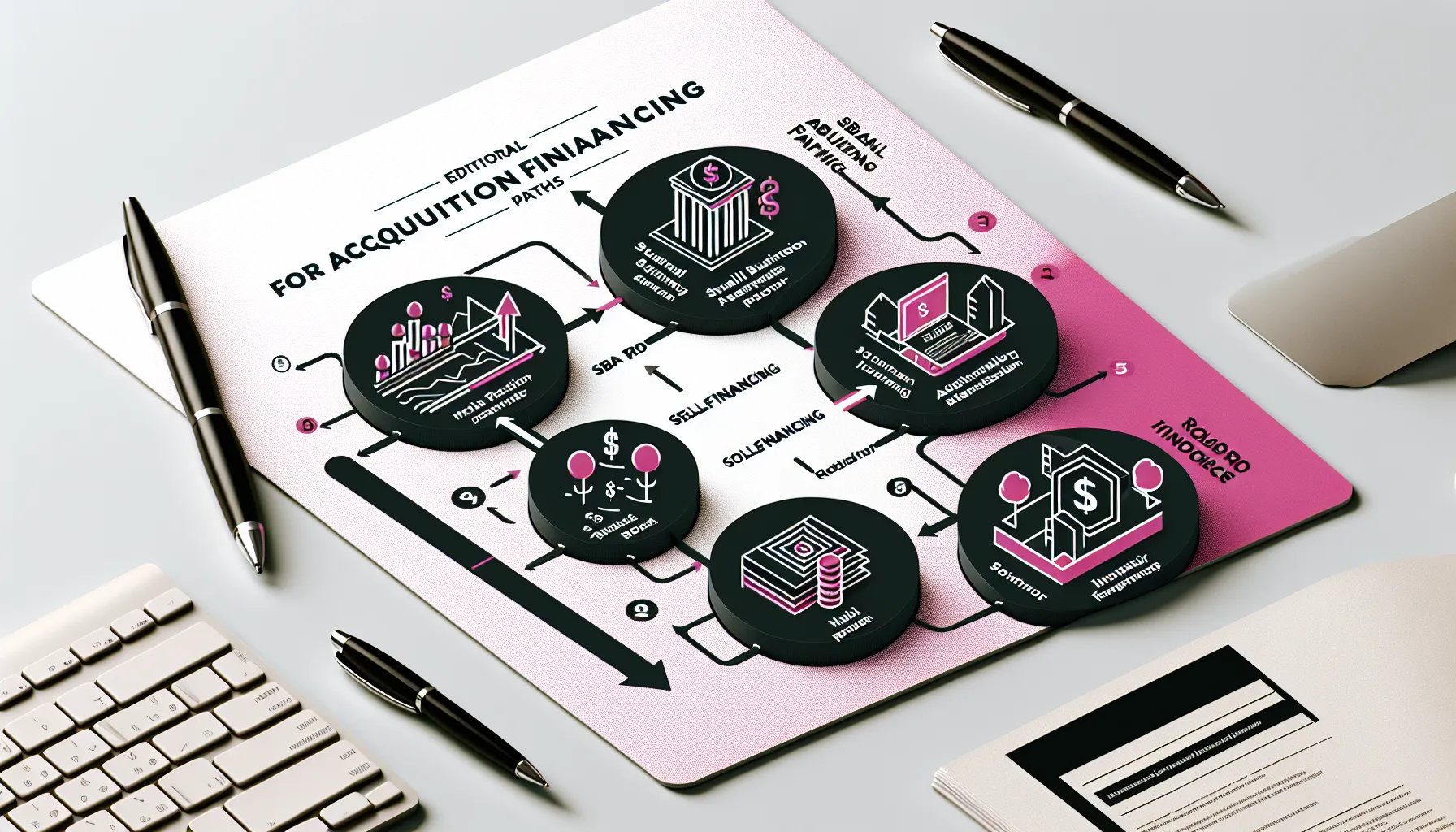
1. SBA 7(a) — The Gold Standard
The SBA 7(a) loan program is the dominant financing vehicle for small business acquisitions. Here’s why: government-backed guarantees allow lenders to extend terms they wouldn’t otherwise offer to an individual borrower.
How it works for acquisitions:
- Loan amounts up to $5 million
- 10–25 year repayment terms depending on how the loan is structured (business acquisition vs. real estate component)
- Down payment: typically 10–20% of purchase price
- Rates: currently floating, tied to prime rate plus a spread
What lenders look at:
- Your personal credit (minimum 680, ideally 700+)
- Your liquidity — do you have enough cash for the down payment plus reserves?
- The target business’s cash flow coverage — can the business service its own debt?
- Your relevant experience — industry background or transferable management experience
The gender-specific reality: Women receive smaller SBA acquisition loans on average and face more requests for additional documentation, co-signers, or collateral than men in comparable financial positions. That’s documented, not anecdotal. The response isn’t to accept it — it’s to understand it, document your application meticulously, and shop lenders. Not all SBA lenders perform the same on gender equity metrics. Some CDFIs and mission-aligned lenders have better track records. See our full breakdown in SBA loans for women for lender-specific guidance.
2. Seller Financing — The Underused Lever
Seller financing means the seller carries a portion of the purchase price as a loan — you pay them back over time from the business’s cash flow instead of borrowing 100% from a bank.
Typical terms:
- 10–30% of purchase price carried by the seller
- 5–7 year repayment term
- Interest rate: 6–8% (negotiable)
- Often subordinate to the SBA loan (seller gets paid after the bank)
Why women should actively negotiate for seller financing:
First, it reduces bank dependency. If you can get the seller to carry 20% of the purchase price, you’re borrowing less from an institution that may be biased against you.
Second — and this is underappreciated — a seller who’s willing to finance part of the deal is a seller who believes the business will cash flow enough to pay them back. It’s a vote of confidence from the one person who knows the business best.
Third, it signals to SBA lenders that the seller has skin in the game post-close. This can actually improve your approval odds on the bank portion.
Push for seller financing in almost every deal. The worst they say is no.
3. Hybrid Structures — Stacking Your Way to a Lower Down Payment
Most acquisition deals aren’t financed with a single source. Sophisticated buyers stack multiple financing layers:
The 10/10/80 structure:
- 10% buyer equity (your down payment)
- 10% seller note (seller carries 10% of purchase price)
- 80% SBA 7(a) loan
This is increasingly common for deals in the $250K–$1.5M range. It lowers your out-of-pocket significantly while staying within SBA guidelines.
Other hybrid structures:
- SBA loan + CDFI loan (mission-aligned lenders that fill gaps)
- SBA loan + equipment financing (finance specific hard assets separately)
- Partial acquisition + earnout (pay the seller more if you hit agreed revenue targets — reduces upfront debt)
Stacking requires a lender who understands structured deals. This is one reason lender selection matters more in acquisitions than in conventional business loans.
4. ROBS — Using Retirement Funds to Buy a Business
ROBS (Rollover for Business Startups) is the mechanism that lets you use your 401(k), IRA, or other qualified retirement funds to buy a business — without paying early withdrawal penalties or taxes.
How it works (simplified):
- A new C-corporation is formed
- The C-corp establishes a qualified retirement plan
- You roll your existing retirement funds into the new plan
- The plan purchases stock in the C-corp
- The C-corp uses those funds to buy the business
The real numbers: IRS guidance on ROBS/401(k) business funding is specific about compliance requirements — this is not a DIY structure.
Who it’s right for:
- Buyers with $100K+ in retirement savings
- Buyers who want to minimize debt (ROBS funds are equity, not debt — no monthly loan payments)
- Buyers who can stomach the compliance overhead (annual 5500 filings, plan administration)
Who it’s wrong for:
- Your entire retirement savings — never put 100% in. The business could fail.
- Buyers who aren’t committed to proper plan administration — the IRS has audited ROBS structures aggressively. Shortcuts create serious tax liability.
ROBS works well as part of a stack: use ROBS funds for your equity down payment, then layer SBA financing on top. You’re reducing the amount you need to borrow while preserving cash.
The Application Playbook — From Target to Close
This is a 4–8 month process for most first-time acquirers. Here’s the sequence that actually works.
Step 1: Get Pre-Qualified Before You Shop
Most buyers make this mistake: they find a business they love, then figure out financing. That’s backwards. Lenders will tell you what they can underwrite before you’ve identified a target — get that number first.
Contact 2–3 SBA lenders (include at least one CDFI or mission-aligned lender) and get pre-qualification letters. Know your borrowing ceiling before you start looking at businesses.
Step 2: Find Your Target
The primary marketplaces:
- BizBuySell — the largest SMB acquisition marketplace
- BizQuest — secondary marketplace with significant inventory
- Industry-specific brokers — for specific sectors (dental, veterinary, childcare), industry specialists often have off-market deals
Working with business brokers: Brokers represent sellers, not buyers. They’re useful because they manage the process, but remember their fiduciary duty runs to the seller. You need your own advisor.
Off-market deals: Some of the best acquisitions happen before a business is officially listed. Direct outreach to owners in industries you know — through NAWBO networks, trade associations, or local business groups — can surface deals that never hit the open market.
SCORE’s business acquisition resources offer free mentoring from advisors who’ve been through the process.
Step 3: LOI and Due Diligence
A Letter of Intent (LOI) is a non-binding agreement that locks in the deal structure (price, terms, exclusivity period) while you conduct due diligence. The LOI gives you typically 30–90 days of exclusivity to investigate the business and finalize financing.
What the bank will require for underwriting:
- 3 years business tax returns
- 3 years personal tax returns
- Interim financial statements (current year through LOI date)
- Business licenses, lease, key contracts
- A/R aging and customer list
- Seller’s explanation of any revenue anomalies
Step 4: Negotiate Deal Structure
Price is the starting point, not the end point. Negotiate:
- Purchase price — based on your due diligence findings, not the asking price
- Seller note terms — push for this aggressively
- Transition period — how long will the seller stay post-close to transfer relationships?
- Non-compete scope — geographic and time limits on what the seller can do after close
- Earnout provisions — for businesses with uncertain future revenue, tie part of the purchase price to performance
Read our guide on negotiating your loan terms for tactics that apply to both bank negotiations and seller negotiations — the principles overlap more than most buyers realize.
Step 5: Loan Packaging
The loan package is the complete submission to your SBA lender. A weak package is a denial. A strong package is an approval.
What goes in:
- SBA Form 1919 (borrower information)
- Personal financial statement
- Business plan (yes, even for acquisitions — document your management approach and growth thesis)
- Full due diligence package from Step 3
- Seller’s transition and training plan
The documentation that women often skip (don’t): A clear narrative section explaining your relevant experience and why you’re the right buyer for this specific business. Lenders use this to fill in gaps. If you don’t write it, they fill in those gaps with assumptions — and those assumptions aren’t always in your favor.
Make sure you’re also actively building business credit before and during this process. Even for an acquisition, lenders look at your business credit profile alongside personal credit.
Step 6: Close and Transition
Closing involves attorneys, wire transfers, and a stack of signatures. Hire a business transaction attorney — not a generalist, a specialist. The cost is $5K–$15K and it’s non-negotiable.
Realistic timeline:
- Month 1–2: Pre-qualification, search begins
- Month 2–4: Target identified, LOI signed, due diligence
- Month 4–6: Loan packaging, underwriting, conditional approval
- Month 6–8: Final approval, closing, transition begins
Eight months is realistic. Four months is aggressive but possible for clean deals with motivated sellers and organized buyers.
Gender-Specific Challenges (And How to Handle Them)
Lender Bias in Acquisition Financing
“Have you run a business before?” is a question that gets asked more frequently, and held to a higher standard, for women than for men in acquisition financing. Men with corporate management backgrounds get credit for transferable experience. Women often get asked to prove it again.
This is documented. The response is preparation, not frustration: build a narrative around your relevant experience before lenders ask. Former nurse buying a home health agency? Lead with your clinical operations background. Former marketing director buying an agency? Document your client management track record.
Understand how to spot lending discrimination — there’s a meaningful difference between a lender asking hard questions (legitimate) and a lender applying a different standard based on gender (illegal). Know that line. Document your interactions.
The Spousal Consent Trap
Some lenders require spousal consent on SBA loans when the spouse has an ownership interest in marital assets used as collateral. This is a specific, limited requirement — not a blanket right for lenders to pull your spouse into the deal.
Know the difference between:
- Spousal consent on collateral — if marital real estate is collateral, the spouse may need to sign off on that specific asset
- Co-borrowing — if a lender is asking your spouse to co-sign the loan itself without clear justification, ask why. Specifically.
If a lender is suggesting your spouse needs to be involved beyond what’s legally required for collateral, that’s worth examining — and potentially worth finding a different lender.
Seller Bias
Some sellers have preferences about who they’ll sell to. You’ll encounter it. The tell is usually a process that drags without explanation, questions that feel personal rather than business-focused, or a seller who’s suddenly “reconsidering” after meeting you.
How to handle it: Move on faster than you think you should. Seller resistance is a problem that compounds at closing and in the transition period. You want a seller who’s enthusiastic about selling to you specifically. If they’re not, the business isn’t worth what the fight will cost you.
Building Your Deal Team
Your deal team for an acquisition should include:
- Business transaction attorney — not your cousin who does wills
- CPA with acquisition experience — specifically someone who has done buy-side due diligence
- Business broker (optional) — can help source and structure deals, but remember they represent sellers
- SBA lender — ideally one with documented equity-focused lending practices
Ask each advisor directly: “Have you worked with women buyers on acquisitions? What did you learn?” How they answer tells you a lot about whether they’ll be useful or whether they’ll add friction.
Lendesca serves as an acquisition lending resource specifically designed for buyers navigating the structural obstacles in SMB acquisition financing — a useful early stop for pre-qualification and lender matching before you’re deep in a deal process.
After Close: The Owner-Operator Transition
You closed. The wire cleared. You own the business. Now the hardest part starts.
Most new owners get this wrong: they buy a business and immediately start changing things. New systems, new processes, new branding, new expectations. The employees who made this business worth buying spend the first 90 days in anxiety, waiting for the next change — and some of the best ones leave.

First 30 Days: Listen, Don’t Change
Your only job in the first 30 days is to understand how the business actually runs — not how the paperwork says it runs. Sit with every key employee. Sit with key customers if you can. Ask questions. Take notes. Change nothing operational.
This isn’t passivity. It’s intelligence gathering. You’re building the credibility to lead by demonstrating that you respect what exists.
First 90 Days: Build Trust, Find Quick Wins
By day 90, you should know where the real problems are and which ones you can solve fast. Pick 2–3 high-visibility, low-disruption improvements and execute them well. A payroll system that actually works. A billing process that doesn’t require three people to run. A customer communication touchpoint that was completely absent.
Quick wins establish your credibility as an operator. They signal to employees and customers that the transition was good for the business.
First Year: Implement Your Vision — Gradually
Major changes — new service lines, staffing restructuring, rebranding, pricing overhaul — belong in year two, not month three. By the end of year one, you should have a deep operating knowledge of the business, strong relationships with key employees, and a clear thesis for where you’re taking it.
The biggest mistake new owners make: Changing too much too fast. The customers you inherited bought from the previous owner’s version of this business. Honor what they bought before you ask them to buy something new.
The Bottom Line
Acquisition is a legitimate, often superior alternative to starting from scratch — particularly for women who’ve spent years building expertise and capital but don’t want to spend another three years proving a concept. You’re buying proof. That’s worth something.
The financing is navigable. SBA 7(a), seller notes, ROBS structures, and hybrid stacks each have their place depending on your capital position and deal structure. The lender bias is real, documented, and — with the right preparation and the right lenders — manageable. Note that new SBA rules effective October 2026 change the DSCR and QoE requirements for acquisition loans — read that before finalizing your deal structure.
The deal team, the documentation, and the lender selection matter as much as the business you choose. Get those right, and the acquisition path is cleaner than most people expect.
Start with pre-qualification. Know your ceiling. Then find the business.